Trustpilot vs Google Reviews: Which Matters More for UK Small Businesses?
Key facts
- Google reviews cost
- Free through Google Business Profile; no invitation limits
- Trustpilot cost
- Free plan with 50 automated invitations a month; Starter from £119 per month per domain, billed annually
- Where they show
- Google: Search and Maps local results. Trustpilot: trustpilot.com, brand-name searches and widgets on your site
- Incentives
- Banned by Google's policy and by Trustpilot's guidelines
- UK law
- Digital Markets, Competition and Consumers Act 2024, Schedule 20, paragraph 13 bans fake reviews
Google reviews are free and shape your Maps and local search visibility. Trustpilot is a separate platform with a free tier and paid plans from £119 a month. Here is how a UK small business should weigh the two.
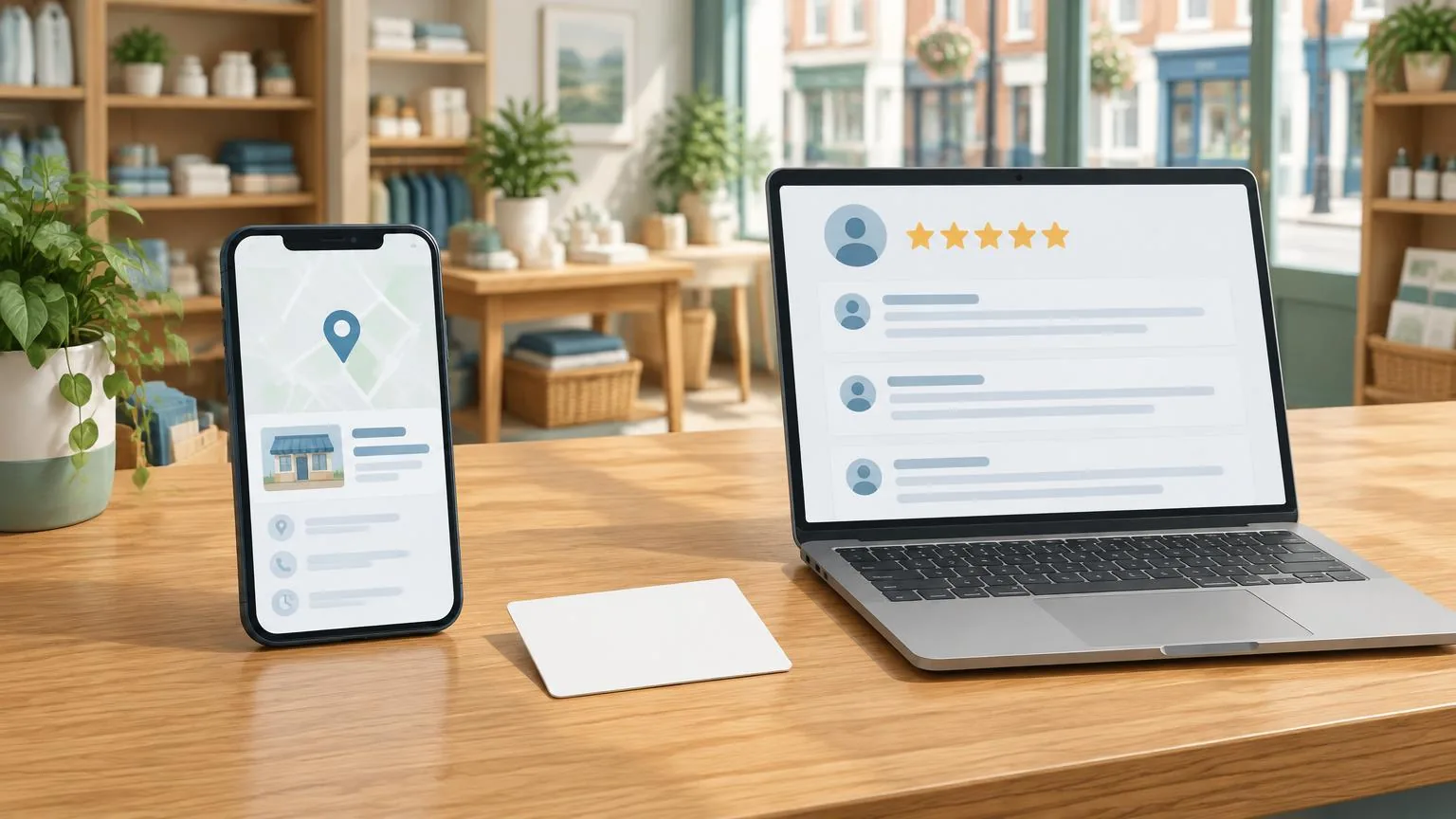
Trustpilot vs Google reviews is not really an either-or choice for a UK small business. Google reviews are free, sit on your Google Business Profile and feed directly into how you appear on Google Maps and in local search. Trustpilot is an independent review platform with a free plan and paid tiers from £119 a month. For most local businesses, Google comes first; Trustpilot earns its place mainly for online sellers.
What is the difference between Trustpilot and Google reviews?
Google reviews are attached to a Business Profile, the listing that appears in Google Search and Google Maps. Trustpilot is a standalone review website, founded in Copenhagen in 2007, that hosts profiles for businesses whether or not they have claimed them. The two platforms collect reviews in different ways, show them in different places and apply their own rules on top of UK law.
| Feature | Google reviews | Trustpilot |
|---|---|---|
| Where reviews appear | Google Search, Google Maps and the local pack | trustpilot.com, your site via widgets, and brand-name search results |
| Who runs it | Google, through Google Business Profile | Trustpilot Group, headquartered in Copenhagen with offices including London and Edinburgh |
| Price for the business | Free | Free plan; Starter from £119 a month per domain; Plus from £289 a month; 12-month commitment |
| Reviewer requirement | Signed in to a Google Account | Over 18 with a recent, genuine experience; a purchase is not required |
| How reviews are gathered | Customers find the listing or follow your review link or QR code | Automated invitations after a purchase, plus unsolicited reviews |
| Effect on local ranking | Google says more reviews and positive ratings can help local ranking | Not part of Google's local ranking signals |
| Google Ads shop ratings | Business Profile reviews are not among the listed sources | Trustpilot is a listed third-party review partner |
Which review platform do UK customers see first?
For a business with a shop, clinic, salon, workshop or office that customers visit, Google reviews are seen first because they appear on the map result a customer is already looking at. Google's own guidance on local ranking says results are based on relevance, distance and prominence, and that prominence is based on information such as how many reviews you have. It states plainly that more reviews and positive ratings can help your business's local ranking.
Trustpilot reviews do not form part of that local calculation. Where Trustpilot does appear is in searches for your brand name, where a Trustpilot profile page often ranks alongside your own website, and in Google Ads. Google lists Trustpilot among the independent review sites it draws on for shop ratings, the star ratings shown under Shopping and text ads. Google says most merchants are able to obtain a rating after collecting 100 or more eligible reviews within the last 24 months, and text ads need an average of 3.5 stars or more to show one. That makes Trustpilot relevant to UK e-commerce businesses running paid search, and far less relevant to a plumber in Leeds or a café in Bristol.
If you want to understand how your Google reviews feed into Maps and local search in more depth, our managing and responding to reviews hub collects the relevant guides in one place.
How much does Trustpilot cost compared with Google reviews?
Google reviews are free. There is no charge to claim a Business Profile, receive reviews, reply to them or share your review link, and Google does not cap how many customers you can ask. Trustpilot has a free plan and paid plans, and the paid plans are priced per domain with a 12-month commitment.
| Plan | Price | Automated invitations a month |
|---|---|---|
| Free | £0 | 50 |
| Starter | From £119 a month per domain, billed annually; for new small business customers | 100 |
| Plus | From £289 a month per domain, billed annually | 300 |
| Premium | Quote from sales | 1,000 |
| Enterprise | Quote from sales | Unlimited |
The free Trustpilot plan is enough to claim your profile, reply to reviews and send a modest number of automated invitations. Custom widgets, more invitations and analytics sit behind the paid tiers. For a sole trader or a small high-street business, the question is whether a second review platform costing more than £1,400 a year on the Starter plan adds anything that free Google reviews do not. Check the Trustpilot plans page for current pricing, as plans change.
Who can leave a review on each platform?
On Google, anyone signed in to a Google Account can leave a review of your Business Profile; Google's Help pages note that a customer can create an account with a non-Gmail address. On Trustpilot, anyone over 18 who has had a recent, genuine experience with your business can write a review, and Trustpilot's guidelines say an experience does not necessarily mean a purchase. Neither platform requires proof of purchase for an unsolicited review.
Both platforms exclude people with a close relationship to the business. Google's policy treats content based on a conflict of interest, including current or former employment, as rating manipulation. Trustpilot's guidelines say the business owner, immediate family, staff and competitors may not review the business. Reviews from your team or relatives are also fake reviews under UK law if they present themselves as ordinary customer experiences.
What are the rules for asking customers for reviews?
You may ask every customer for a review on either platform, but you may not reward them and you may not pick who gets asked. Trustpilot's guidelines tell businesses to invite consistently and fairly, inviting everyone in the same way, and prohibit being selective about which customers you invite or timing invitations so that only happy customers receive them. They also state that incentivised reviews are not allowed, listing discounts, promo codes, prize-draw entries, refunds and freebies as examples.
Google's rules are the same in substance. Google Business Profile Help describes offering free or discounted goods or services in exchange for reviews as strictly prohibited, and Google's content policy bans discouraging negative reviews or selectively soliciting positive ones. On top of both sets of platform rules sits the Digital Markets, Competition and Consumers Act 2024. Since April 2025, Schedule 20, paragraph 13 has banned fake reviews, concealed incentivised reviews and false or misleading review information. The Competition and Markets Authority's guidance (CMA208) confirms that asking customers generally whether they would like to leave a review is not prohibited, as long as you do not predetermine what they say. Our article on the DMCC Act and fake reviews covers the UK law in detail, and our explainer on review gating shows why filtering customers before you ask breaks the rules on both platforms.
In practice the compliant method is the same everywhere: ask everyone, at the same point, with no reward. For a business that serves customers face to face, that usually means putting your Google review link where every customer can reach it. A printed Google Review Card with an NFC chip and a QR code opens your review form when a customer taps or scans it, so staff can offer it to each customer in the same way without singling anyone out. Trustpilot's model, by contrast, is built around emailed invitations after an online order, which suits web shops more than counters.
How does each platform deal with fake reviews?
Both platforms remove fake reviews, but they are transparent about it in different ways. Trustpilot publishes an annual Trust Report. Its 2025 report states that it removed 4.5 million fake reviews in 2024, which it says was 7.4% of all reviews submitted that year, and that 90% of those were removed automatically by machine-learning systems. Businesses can flag reviews that breach the guidelines, but Trustpilot warns that disagreeing with a star rating is not a valid reason, that flagged reviews stay visible during the investigation, and that businesses should flag five-star and one-star reviews on the same grounds.
Google does not publish equivalent UK figures, but it has given formal undertakings to the CMA. Announced on 24 January 2025, these commit Google to placing a prominent warning alert on the profiles of UK businesses found to have boosted their star rating with fake reviews, to switching off the review function for repeat offenders and deleting their reviews for six months or more, to barring people who repeatedly post fake reviews for UK businesses, and to providing a reporting tool for consumers. The CMA estimates that as much as £23 billion of UK consumer spending is potentially influenced by online reviews each year, which explains the attention. If a review on your Google profile breaks the rules, our guide on whether you can remove a Google review walks through the reporting process.
Should a UK small business use Trustpilot or Google reviews?
Start with Google, and add Trustpilot only if you sell online or run Google Ads where shop ratings matter. The decision follows from where your customers meet you.
Claim and verify your Google Business Profile. It is free and it is where local customers will look first.
Find your Google review link and put it in front of every customer in the same way: on receipts, in follow-up messages, or on a card, stand or sticker at the point of service. Our guide to finding your Google review link shows where it lives.
Reply to every Google review, positive or negative. Google says helpful replies can help your business stand out, and our response examples give you wording to adapt.
If you sell online, claim your free Trustpilot profile. It already exists whether you have claimed it or not, and claiming lets you reply.
If you run Google Shopping or text ads and want shop ratings, consider whether a paid Trustpilot plan is justified by your ad spend, and compare it with Google Customer Reviews, which is free through Merchant Center.
Apply one asking policy across both platforms: invite everyone, never reward a review, and never filter customers by how happy they seem.
A pub in Manchester, a dental practice in Glasgow or a mobile dog groomer in Cardiff will gain more from a steady flow of Google reviews than from a Trustpilot profile that few of their customers will ever visit. A UK web shop shipping nationwide may want both, because Trustpilot's invitation flow fits an order confirmation and its reviews can feed Google Ads shop ratings. Whichever you choose, the rules on asking are the same, and so is the one habit that matters most: ask every customer, every time.
This article compares the two platforms in plain English and is not legal advice. Platform terms and prices change; check the Trustpilot plans page, Google's policies and the CMA's guidance for the current position, or speak to a solicitor about your specific situation.
❓ Frequently asked questions
Is Trustpilot free for UK businesses?
Trustpilot has a free plan that lets you claim your profile, reply to reviews and send 50 automated invitations a month. Paid plans on the UK site start at £119 a month per domain, billed annually, with a 12-month commitment.
Do Trustpilot reviews help my Google ranking?
Not for local results. Google's local ranking guidance refers to the reviews on your Business Profile, not third-party sites. Trustpilot reviews can contribute to Google Ads shop ratings and often appear in searches for your brand name.
Can I ask for Google reviews and Trustpilot reviews at the same time?
Yes, as long as you ask every customer in the same way and offer no reward. Both platforms prohibit incentives and selective invitations, and the DMCC Act 2024 bans fake and concealed incentivised reviews in the UK.
Does a customer need an account to leave a review?
On Google, customers must be signed in to a Google Account, which can use a non-Gmail email address. On Trustpilot, anyone over 18 with a recent, genuine experience can review, and a purchase is not required.
Which is better for a UK shop or tradesperson, Trustpilot or Google?
For businesses customers visit or call locally, Google reviews matter more because they appear on Maps and in local search results. Trustpilot is most useful for online retailers and businesses that want shop ratings in Google Ads.
Sources
- Trustpilot UK: Plans and pricing
- Trustpilot: Guidelines for businesses
- Trustpilot: Trust Report 2025 (press release)
- Google Business Profile Help: How to improve your local ranking on Google
- Google Business Profile Help: Get reviews on Google
- Google Maps user-contributed content policy
- Google Ads Help: About shop ratings
- CMA: Fake reviews guidance (CMA208)
- GOV.UK: CMA secures important changes from Google to tackle fake reviews
Related articles
The DMCC Act and Fake Reviews: What UK Small Businesses Must Know
The DMCC Act made fake reviews a banned practice in the UK from 6 April 2025. Here is what that means for a small business asking customers for Google reviews.
How to Respond to Google Reviews (With Examples)
A practical guide to replying to Google reviews: where to click, what Google advises, and example replies for positive, mixed, negative and fake reviews.
How to Remove a Google Review: What Businesses Can Do
Businesses cannot delete Google reviews, but Google removes ones that break its policies. How to report, appeal, use legal routes and handle reviews that stay.