Fake Review Rules in India: What the CCPA, IS 19000 and the E-Commerce Rules Mean for Your Business
Key facts
- Main law
- Consumer Protection Act, 2019 (unfair trade practices, CCPA)
- E-commerce
- Consumer Protection (E-Commerce) Rules, 2020, Rule 6: sellers must not pose as consumers and post reviews
- Standard
- IS 19000:2022, Online Consumer Reviews (BIS), voluntary as of March 2026
- Regulator
- Central Consumer Protection Authority (CCPA), Department of Consumer Affairs
- Paid, incentivised and conflict-of-interest reviews are prohibited on Google Maps
India has no single fake review law, but the Consumer Protection Act 2019, the E-Commerce Rules 2020 and BIS standard IS 19000:2022 together set clear limits. Here is what they mean when you ask customers for Google reviews.
The fake review rules in India come from three places rather than one Act: the Consumer Protection Act, 2019, which treats false representations made to promote a business as an unfair trade practice; the Consumer Protection (E-Commerce) Rules, 2020, which stop sellers posing as customers; and the Bureau of Indian Standards (BIS) standard IS 19000:2022 on online consumer reviews. Asking real customers for honest Google reviews is allowed under all three. Writing, buying or rewarding reviews is not.
Is it illegal to post fake reviews in India?
There is no section of Indian law headed "fake reviews", but a fake review is a false representation about your own goods or services, and that is squarely an unfair trade practice. Section 2(47) of the Consumer Protection Act, 2019 defines an unfair trade practice as a practice which, for the purpose of promoting the sale of goods or services, adopts any unfair method or deceptive practice, including making any statement "whether orally or in writing or by visible representation including by means of electronic record" which falsely represents that goods are of a particular standard or quality. A five-star review written by the owner, a cousin or a paid freelancer, dressed up as a customer's experience, fits that definition.
The Act also created the Central Consumer Protection Authority (CCPA), which investigates unfair trade practices and misleading advertisements, issues notices and imposes penalties. In a reply to the Lok Sabha dated 25 March 2026, the Department of Consumer Affairs reported that the CCPA had issued 477 class-action notices and imposed penalties of ₹3,00,40,500 as of 9 March 2026. Those figures cover all misleading advertising and unfair trade practice cases, not reviews alone, but they show the regulator is active. For false or misleading advertisements specifically, Section 21 of the Act allows penalties of up to ₹10 lakh for a first contravention and up to ₹50 lakh for each subsequent one, and endorsers can be barred from endorsing for up to one year, or three years on repeat.
If you publish fake reviews on your own website or in your marketing, you risk being treated both as the business making a false representation and as the publisher of a misleading advertisement. Do not assume a kirana store, clinic or salon is too small to be noticed; a complaint to the National Consumer Helpline (1915) is one of the routes by which cases reach the CCPA.
What do the E-Commerce Rules 2020 say about reviews?
The Consumer Protection (E-Commerce) Rules, 2020, notified on 23 July 2020, contain India's most direct written ban on fake reviews. Rule 6 sets out the duties of sellers on marketplaces: a seller shall not adopt any unfair trade practice, and shall not falsely represent itself as a consumer and post reviews about goods or services, or misrepresent their quality or features. Rule 4 separately prohibits e-commerce entities themselves from adopting unfair trade practices. The Department of Consumer Affairs summarised the position in its March 2026 Lok Sabha reply: sellers "are prohibited from posting misleading reviews or misrepresenting product features".
Strictly, these Rules bind sellers on e-commerce platforms such as marketplaces and food-delivery apps rather than a physical shop collecting Google reviews. But the principle they state, that a business must never pretend to be its own customer, is the one the Consumer Protection Act applies everywhere else.
What is IS 19000:2022 and does it apply to my business?
IS 19000:2022, "Online Consumer Reviews: Principles and Requirements for their Collection, Moderation and Publication", is a Bureau of Indian Standards standard notified on 23 November 2022 and launched by the Department of Consumer Affairs on 12 December 2022. It is adapted from the international standard ISO 20488:2018. It applies to any organisation that publishes consumer reviews online, which expressly includes sellers who collect reviews from their own customers, third parties contracted by sellers and independent review platforms. Its seven guiding principles are integrity, accuracy, privacy, security, transparency, accessibility and responsiveness.
If you only ask customers to review you on Google, the "review administrator" that must collect, moderate and publish under the standard is Google, not you. The standard becomes directly relevant the moment you display reviews on your own website or app, run your own testimonial page, or hire an agency to gather and publish reviews for you.
| Requirement | What it means in practice |
|---|---|
| No purchased reviews | Do not knowingly publish reviews that were bought, or written by people employed to write them |
| Rewards cannot depend on content | Any reward must not be tied to a positive review, and rewarded reviews must carry a visible mark and be excluded from the overall rating |
| No editing | The publisher cannot edit a review; only the author can, and post-publication edits must be marked |
| Fair invitations | Review requests go to all known purchasers, or to a selection chosen by an objective, demonstrable process that minimises bias |
| No suppressing negatives | Publication cannot be held back because of discussions with the seller; negative reviews are not filtered out |
| Verified authors | The publisher checks that the reviewer is a real person, for example by email, SMS or one-account-per-address rules |
| Records | Removed reviews and the reasons for removal are kept for at least 180 days |
Is IS 19000 mandatory yet?
No. As of the Department of Consumer Affairs' reply to the Lok Sabha on 25 March 2026, the standard is voluntary and "applicable to every online platform which publishes consumer reviews". The government has, however, been working on making it compulsory. On 15 May 2024 the Department held a stakeholder consultation, attended by Google, Amazon, Meta and Flipkart among others, on a draft Quality Control Order (QCO) under Sections 16 and 25 of the Bureau of Indian Standards Act, 2016 that would make IS 19000 binding.
Reports of the draft QCO described a six-month implementation window for large and medium enterprises and all aggregators, 12 months for small enterprises and 18 months for micro-enterprises. The draft would prohibit paid or fake reviews, rewards tied to reviews, editing reviews to change their meaning, and blocking or discouraging negative reviews. The background was a sharp rise in e-commerce grievances to the National Consumer Helpline, from 95,270 in 2018 to 4,44,034 in 2023. Treat the QCO as pending rather than law, but build your review process so that it would already comply.
Can I ask customers for Google reviews in India?
Yes. None of the Indian rules stop you asking a genuine customer to share their honest opinion, and Google's own Business Profile help says you can ask customers to visit a Google link or scan a QR code to leave a review. The legal line is crossed only when the review is not genuine, when the reviewer is rewarded for it, or when you filter who gets asked so that only happy customers reach the form.
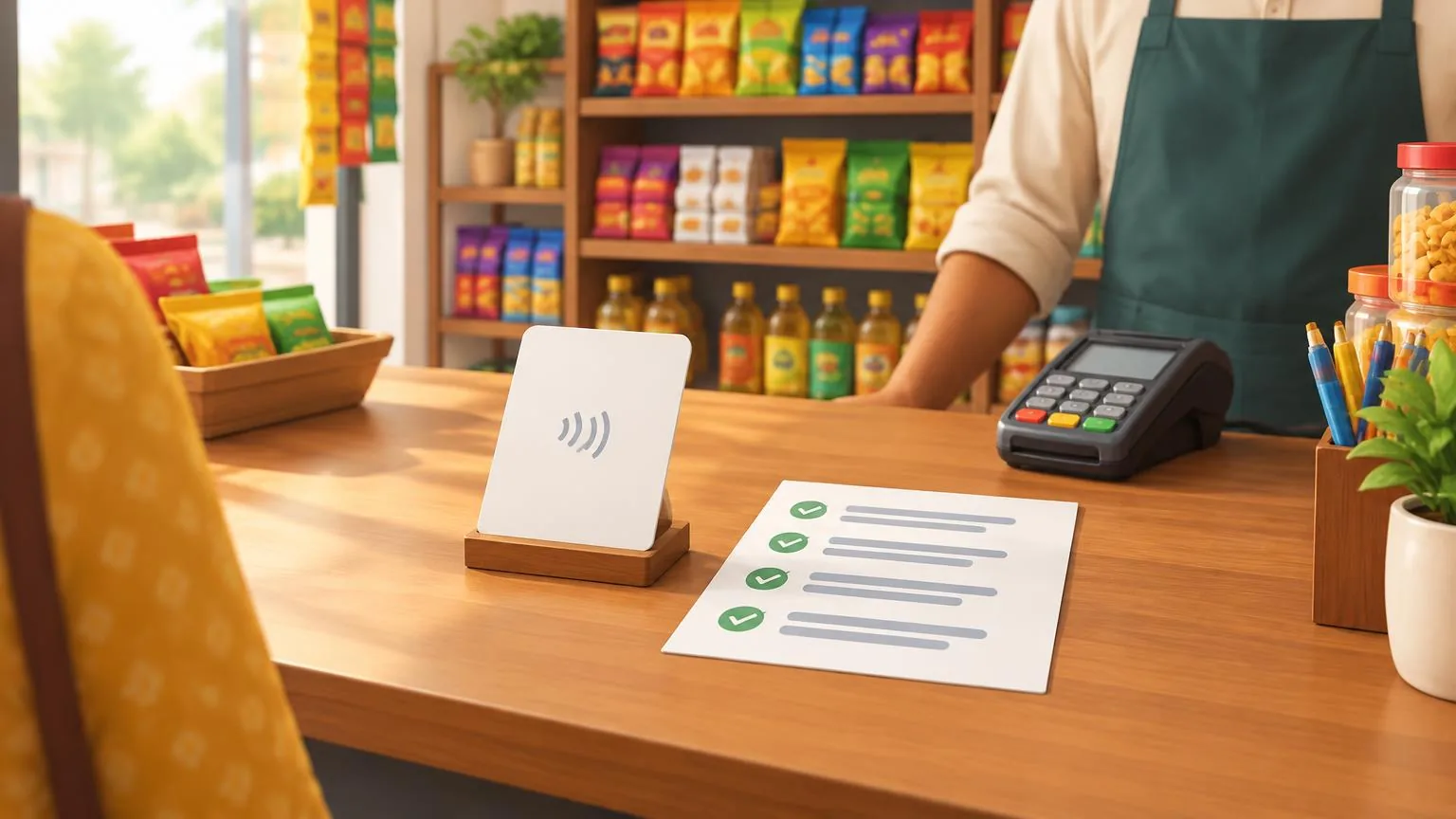
In practice the cleanest way to stay on the right side of the line is to put the same request in front of every customer at the same moment. A tap-and-scan Google review card at the billing counter, or a review standee at reception, opens your Google review form for whoever uses it. The customer chooses their own star rating and writes their own words, which is exactly what Google and the Consumer Protection Act expect. Our wider guide to review rules and compliance covers the other markets we serve.
Can I offer a discount or gift for a Google review in India?
Not for Google reviews. Google's Business Profile help states that offering incentives, such as free or discounted goods or services, in exchange for customers posting reviews is treated as fake and misleading content and is "strictly prohibited". The Google Maps user-contributed content policy likewise bans reviews "that have been paid for, directly or in kind" and bans merchants from offering incentives in exchange for posting a review or removing a negative one. IS 19000 permits a reward only if it does not depend on the review's content and the review is marked as rewarded, but on Google no incentive is allowed at all. A free chai for a five-star rating is a policy breach, and an undisclosed reward for a positive review risks being treated as a deceptive practice under the Consumer Protection Act as well.
Can my staff, family or an agency write reviews for me?
No. Under the Consumer Protection Act a review that falsely presents an insider's statement as a customer's experience is a false representation, and under Rule 6 of the E-Commerce Rules a seller may not pose as a consumer. Google's policy separately prohibits content "based on a conflict of interest", which it says may include current or former employment, industry competitors and family relationships, and prohibits content posted from multiple accounts by or at the request of one person. Agencies that promise a fixed number of reviews or a target rating can only deliver by breaking these rules, and Google says the consequences range from suspending account privileges to account termination. Our article on how fake reviews damage a business explains why the short-term gain is not worth it.
Is review gating allowed in India?
Review gating, where you first ask customers how they feel and only send the happy ones to Google, is prohibited by Google's policy, which bars merchants from discouraging negative reviews or selectively soliciting positive ones. The draft QCO on IS 19000 would ban blocking or discouraging negative reviews as well, and the standard already requires invitations to go to all known purchasers or an objectively chosen sample. If you use WhatsApp or SMS to request reviews, send the same message to everyone. Read our explainer on review gating and why to avoid it before setting up any automated flow.
A compliance checklist for Indian small businesses
Ask every customer, in the same way, at the same point: at billing, at checkout, or when the service is finished.
Never offer discounts, cashback, gifts or lucky-draw entries for Google reviews, even with a disclosure.
Do not write reviews yourself, and do not ask staff, relatives or suppliers to review you as if they were customers.
Refuse any agency or app that promises a number of reviews or a star rating, or that offers to "remove" negatives for a fee.
If you show reviews on your own website, publish a fair selection, do not edit them, and mark any that were rewarded.
Do not pre-screen customers before giving them the review link; a card, standee or QR sticker that every customer can use keeps the request neutral.
Reply to negative reviews courteously and keep your own records of any review you flag to Google and why.
Keep a one-page written review policy so new staff know the rules from day one.
This article explains the Indian rules in plain language and is not legal advice. For a specific situation, read the Consumer Protection Act, 2019, the E-Commerce Rules, 2020 and IS 19000:2022 in full, or consult an advocate.
❓ Frequently asked questions
Which law covers fake reviews in India?
Mainly the Consumer Protection Act, 2019, under which a fake review is an unfair trade practice, supported by Rule 6 of the Consumer Protection (E-Commerce) Rules, 2020, which stops sellers posing as consumers to post reviews. BIS standard IS 19000:2022 sets out best practice for anyone publishing reviews.
Is IS 19000:2022 mandatory for businesses in India?
Not yet. According to the Department of Consumer Affairs' reply to the Lok Sabha on 25 March 2026, the standard is voluntary. A draft Quality Control Order to make it mandatory was discussed with platforms in May 2024 but had not been notified at that date.
What is the penalty for fake reviews in India?
There is no fixed fake-review fine. The CCPA can act against unfair trade practices, and for false or misleading advertisements Section 21 of the Consumer Protection Act, 2019 allows penalties of up to ₹10 lakh, rising to ₹50 lakh for repeat contraventions. Google can also remove the reviews and restrict the accounts involved.
Can I ask customers for Google reviews in India?
Yes. Asking real customers for an honest review, for example through a review link, QR code or tap card, is allowed by Indian law and by Google. You must not reward the review, write it yourself or ask only happy customers.
Can I give a discount for a Google review in India?
No. Google's policy prohibits any incentive, including discounts, free items or lucky draws, in exchange for a review. An undisclosed reward for a positive review also risks being treated as a deceptive practice under the Consumer Protection Act, 2019.
Sources
- Lok Sabha Unstarred Question No. 5415, Ministry of Consumer Affairs reply, 25 March 2026
- PIB: BIS issues standards for organisations publishing consumer reviews (IS 19000:2022), 12 December 2022
- MediaNama: Summary of the BIS standard on online consumer reviews
- MediaNama: Consumer Affairs Department holds consultation on reducing fake reviews online (May 2024)
- Storyboard18: Proposed Quality Control Order for e-commerce firms on fake reviews
- HSA Advocates: The Consumer Protection (E-Commerce) Rules, 2020 explained
- Consumer Protection Act, 2019, Section 21: penalties for false or misleading advertisements
- Google Maps user-contributed content policy
- Google Business Profile Help: Get reviews on Google
Related articles
Are Review Cards Allowed by Google?
Yes — a card that simply opens your Google review page is allowed. Here's what Google's policy says, and where the line is.
Fake Google Reviews: How to Spot, Report and Protect Yourself
How to recognize a suspicious Google review, report it through your Business Profile, reply calmly while it's checked, and keep your own review collection above suspicion.
Google Review Standee Buying Guide for Indian Businesses
A Google review standee puts your review link on the billing counter. Here is what to check before you buy one in India, from NFC and QR options to placement beside your UPI code.