NFC vs QR Review Cards: Which Gets US Businesses More Google Reviews?
Key facts
- Question answered
- NFC tap versus a printed QR code
- NFC
- Tap the phone to the card; no camera needed
- QR
- Works on any phone with a camera
- Our products
- Include both on most options
- Same destination
- Your Google review page
How American small business owners — restaurants, salons, HVAC, dental, auto, retail — should choose between NFC and QR review cards for conversion, cost, and ease of use.
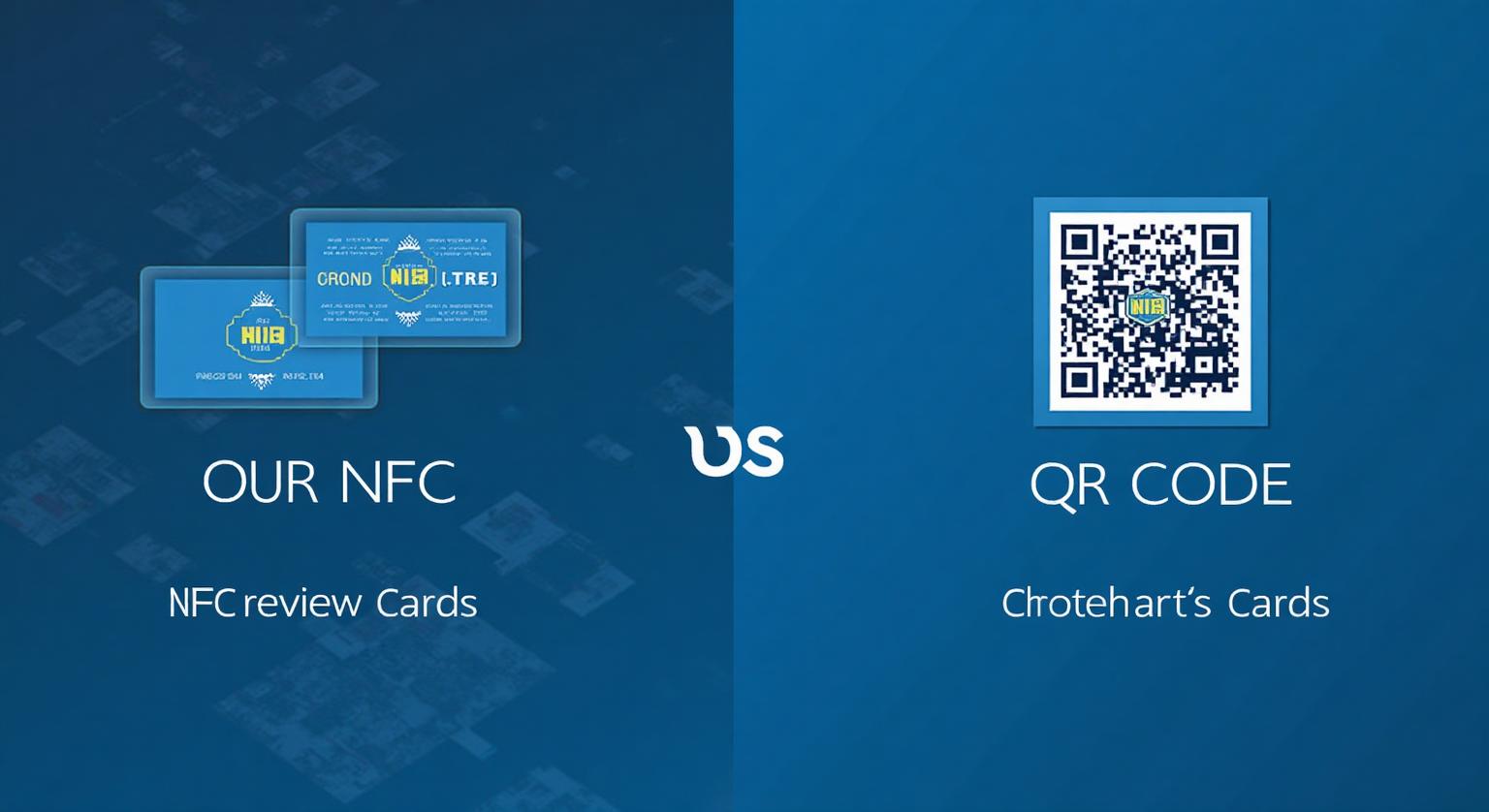
NFC review cards remove more steps than a printed QR code because a tap opens the review page directly, while a QR code still requires opening the camera app and holding it steady. Both are Google-compliant ways to point a customer to your review page. Many businesses use both together: NFC for in-person moments and QR for anything the customer isn't standing right next to.
What Does Each Option Feel Like to a Customer?
NFC removes a step by opening the review page the instant a phone is held near the card, while a QR code requires the customer to open a camera first.
With NFC, a customer at your checkout counter taps their phone against a printed card. A notification appears, they tap it, and the Google review screen for your business opens directly. With a printed QR code, the customer unlocks their phone, opens the camera, holds it steady over the code, waits for a link banner to appear, then taps it. Both land on the same review page; NFC simply removes a couple of those manual steps.
Where Does a QR Code Still Make Sense?
QR codes work well anywhere the customer can't physically touch your card, such as printed materials seen from a distance.
That includes takeaway packaging, printed receipts, mailers, outdoor signage, yard signs, window decals, and any campaign where you're distributing many touchpoints at a low unit cost. A QR code also serves as the fallback on a hybrid card for the phones that don't read NFC.
Where Does NFC Make the Most Sense?
NFC makes sense anywhere a customer is standing at, sitting at, or paying at a surface you own.
That covers sit-down restaurants and diners, quick-service counters, coffee shops, hair and nail salons, barbershops, gyms, dental and orthodontic practices, med spas, chiropractors, hotel and short-term-rental reception, tattoo studios, auto repair shops, pet groomers, boutique retail, and home-services teams (HVAC, plumbing, electric) that finish a job face-to-face with the customer.
How Should You Think About the Cost of Each?
A printed QR code costs less per unit, while an NFC card is a reusable one-time purchase.
Printed QR materials are cheap to produce in volume but wear out and need reprinting. An NFC card costs more upfront but is designed to be reused for as long as the business needs it. The more useful comparison isn't the unit price — it's how many extra reviews a format helps you collect relative to what it costs to deploy.
What Does Google's Ranking System Actually Reward?
Google's local ranking system doesn't care whether a review came from a tap or a scan — it rewards more reviews, earned consistently, from real customers.
The format itself isn't a ranking factor. What matters to Google's local algorithm is review count relative to competitors, how consistently new reviews come in, and how recent they are. Whichever format helps you collect honest reviews more reliably from more customers will support those signals more effectively.
Why Do Many Businesses Use a Hybrid Card?
A hybrid card works because it covers customers whether or not their phone supports NFC.
Printing a QR code on the same card as the NFC chip means every customer is covered — a tap for phones that support it, a scan for the ones that don't. This is the setup most review card suppliers now use by default.
How Should You Roll This Out?
- Place a hybrid NFC + QR card at every guest-facing station: check presenter, host stand, front desk, checkout, service bay, styling chair
- Train staff on a single neutral line: "If you enjoyed today, a quick Google review really helps us."
- Place the card where the customer's phone already is — next to the receipt, on top of the check presenter, on the reception tablet
- Ask every customer the same way — never offer a discount, freebie, or contest entry for a review, and never filter who gets asked based on how happy they seem
What's the Bottom Line?
If your customers stand in front of you, a tap card removes the most friction; if they take something home, a QR code travels with it. Most businesses end up using both — a hybrid card at the counter covers every phone, while QR-only materials handle anything printed for later.
Sources
- https://support.google.com/business/answer/3474122 — Google Business Profile help: Get reviews on Google.
- https://support.google.com/contributionpolicy/answer/7422880 — Google Maps user-generated content policy.
- https://support.google.com/contributionpolicy/answer/7400114 — Prohibited & restricted content (Maps policy).
❓ Frequently Asked Questions
Are NFC review cards better than QR codes for small businesses?
For in-person moments at a counter, table, or front desk, NFC removes more friction than a QR code because it doesn't require opening a camera app. QR remains useful for take-home materials like receipts, packaging, and yard signs.
Do all iPhones and Androids support NFC review cards?
Most modern iPhones and Androids support NFC. Phones that don't can use the QR code printed on the back of a hybrid card instead.
Will Google penalize a business for using NFC or QR review cards?
No. Google permits any tool that helps customers leave honest, unincentivized reviews. What Google prohibits is offering an incentive for a review or filtering which customers get asked, regardless of whether the ask came via NFC, QR, email, or text.
Should restaurants use NFC or QR for review cards?
A card on the check presenter with both NFC and a QR code covers customers either way, since not every diner's phone will read NFC the same way.
Can one card include both NFC and QR?
Yes, and most review card suppliers include both by default so every phone is covered without staff needing to explain the difference.
Does NFC always convert better than QR?
NFC generally removes more friction because it skips the camera step, but the honest answer is that we don't have an independent, controlled study to cite an exact multiplier. What we can say is that fewer steps between intent and submission tends to mean fewer people give up along the way.
Related Guides & Tools
Hand-picked next reads for US small businesses growing their Google reviews.
Explore Our Products
Google Review Card
NFC tap cards that take customers straight to your Google review page.
Google Review Stand
Countertop stands perfect for restaurants, salons, and reception desks.
Google Review Plaque
Wall-mounted plaques that collect reviews in high-traffic areas.
Google Review Stickers
Peel-and-stick NFC stickers for windows, doors, and counters.
Google Review Keychains
Portable keychains your team can carry to collect reviews anywhere.
NFC Wristband
Wearable NFC wristbands for events, trade shows, and on-the-go reviews.
Ready to Get More Google Reviews?
Start collecting reviews instantly with NFC Google Review Cards.
Shop NowRelated Articles
NFC Review Cards vs Printed QR Cards – Cost & Performance
QR cards look cheaper on paper. But when you factor in conversion rates, lifespan, and cost per review, the numbers tell a very different story.
Why NFC Review Cards Are the Future of Review Collection
Emails get ignored. SMS feels spammy. QR codes are fading. Here's why NFC is rapidly becoming the new default for ethical review collection.