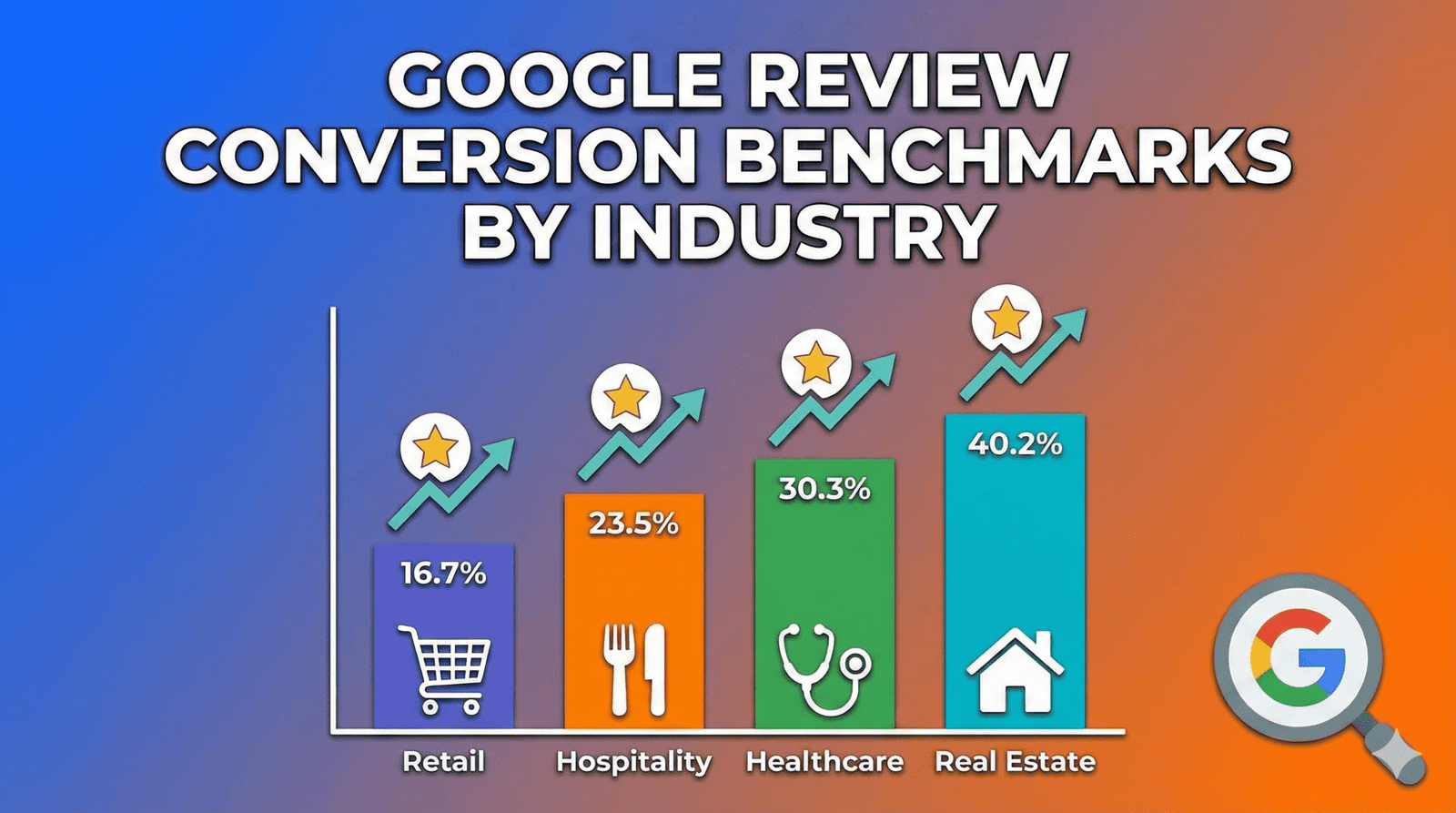
A review conversion rate tells you how many of the customers you invited actually left a review. Published benchmarks vary widely and rarely match your situation, so this guide shows Indian businesses how to measure their own rate and improve it.
Almost every business owner in India asks the same question after putting a Google review card on the counter: ‘kitna review aana chahiye normally?’ The honest answer is that there is no reliable published benchmark. Results depend on your category, footfall and how consistently your team asks. The most useful benchmark is your own — measured before and after you change something.
Why Industry Benchmarks Mislead
Figures you see online for ‘reviews per 100 customers’ are rarely sourced and rarely comparable. A café with long dwell time, a QSR counter and a home-service team meet customers in very different moments. Google doesn't publish a target review count or a review rate for any category, so compare yourself with your own past results rather than someone else's number.
How to Measure Your Own Baseline
Count the Google reviews you received in the last 90 days from your Business Profile.
Count customers served in the same period from your billing software, POS or appointment book.
Work out reviews per 100 customers. That is your baseline.
Introduce one change — a card at the billing counter, a stand at reception, or a trained one-line ask.
Measure again after a comparable period and compare like with like (avoid comparing Diwali season with a quiet month).
| Metric | Where to find it | Why it matters |
|---|---|---|
| New reviews | Google Business Profile | Shows whether the ask is happening consistently |
| Customers served | Billing software, POS or appointment book | Lets you turn review counts into a rate |
| Reviews replied to | Google Business Profile | Replying shows customers you value their feedback |
| Average rating trend | Google Business Profile | Flags service problems early |
What Makes Some Businesses Collect Reviews More Easily
- A natural pause — waiting for the bill at a restaurant, drying time at a salon, check-out at a hotel
- Face-to-face handover — a plumber, electrician or AC technician finishing a job at the customer's flat
- A clear, familiar prompt — a card or stand placed where customers already look, such as beside the UPI sound box
- Staff who ask every customer the same way, every shift
Ask every customer, not only the ones who seem happy. Selectively asking for positive reviews breaks Google's policy — see why review gating backfires.
A Healthy Rating Mix
A healthy profile is usually mostly five-star with some four-star reviews and the occasional lower rating. A profile with nothing but five-star reviews can read as less believable to shoppers. A few three- and four-star reviews aren't a problem — they show the reviews are genuine.
Replying to Reviews
Reply to every review you can, in the customer's language where possible. Google says replying ‘shows that you value their feedback’, and notes that more reviews and positive ratings can help local ranking — but there is no way to pay for or request a better ranking (Google Business Profile Help).
❓ Frequently asked questions
My café serves 800 customers a month — what's a realistic monthly review target?
There is no standard figure. Measure your current reviews per 100 customers, add a card at the counter with a consistent ask, and aim to beat your own baseline.
Is a 4.9-star average better than a 4.7-star?
Google doesn't publish a rating threshold for ranking. A believable mix of recent, detailed reviews with thoughtful replies matters more to shoppers than a tiny difference in the average.
How long before I see more reviews after starting?
It varies. Reviews usually pick up gradually as staff get comfortable with the ask and it becomes part of the routine.
Should I compare my review count with the top business in my area?
It's useful context, but focus on getting steady, genuine reviews from your own customers. Google ranks local results mainly on relevance, distance and prominence, not on review count alone.
Related Guides & Tools
Hand-picked next reads for Indian small businesses growing their Google reviews.
Explore Our Products
Google Review Card
NFC tap cards that take customers straight to your Google review page.
Google Review Stand
Countertop stands perfect for restaurants, salons, and reception desks.
Google Review Plaque
Wall-mounted plaques that collect reviews in high-traffic areas.
Google Review Stickers
Peel-and-stick NFC stickers for windows, doors, and counters.
Google Review Keychains
Portable keychains your team can carry to collect reviews anywhere.
NFC Wristband
Wearable NFC wristbands for events, trade shows, and on-the-go reviews.
Related articles
The ROI of Improving Google Reviews for Local Businesses
Google reviews can affect how visible and trustworthy your business looks in local search. How reviews connect to revenue, what Google actually says, and how to measure the return for your own business.
How Many Google Reviews Do You Need to Rank Higher?
Google doesn't publish a magic number. Here's how to judge where you stand against local competitors, and what matters beyond the count.