Best Google Review Card Designs in India 2026 to Get More Reviews
From Mumbai cafés and Bengaluru salons to Delhi NCR clinics — these card designs are the ones Indian customers actually tap. Real ₹ pricing and proven layouts for 2026.
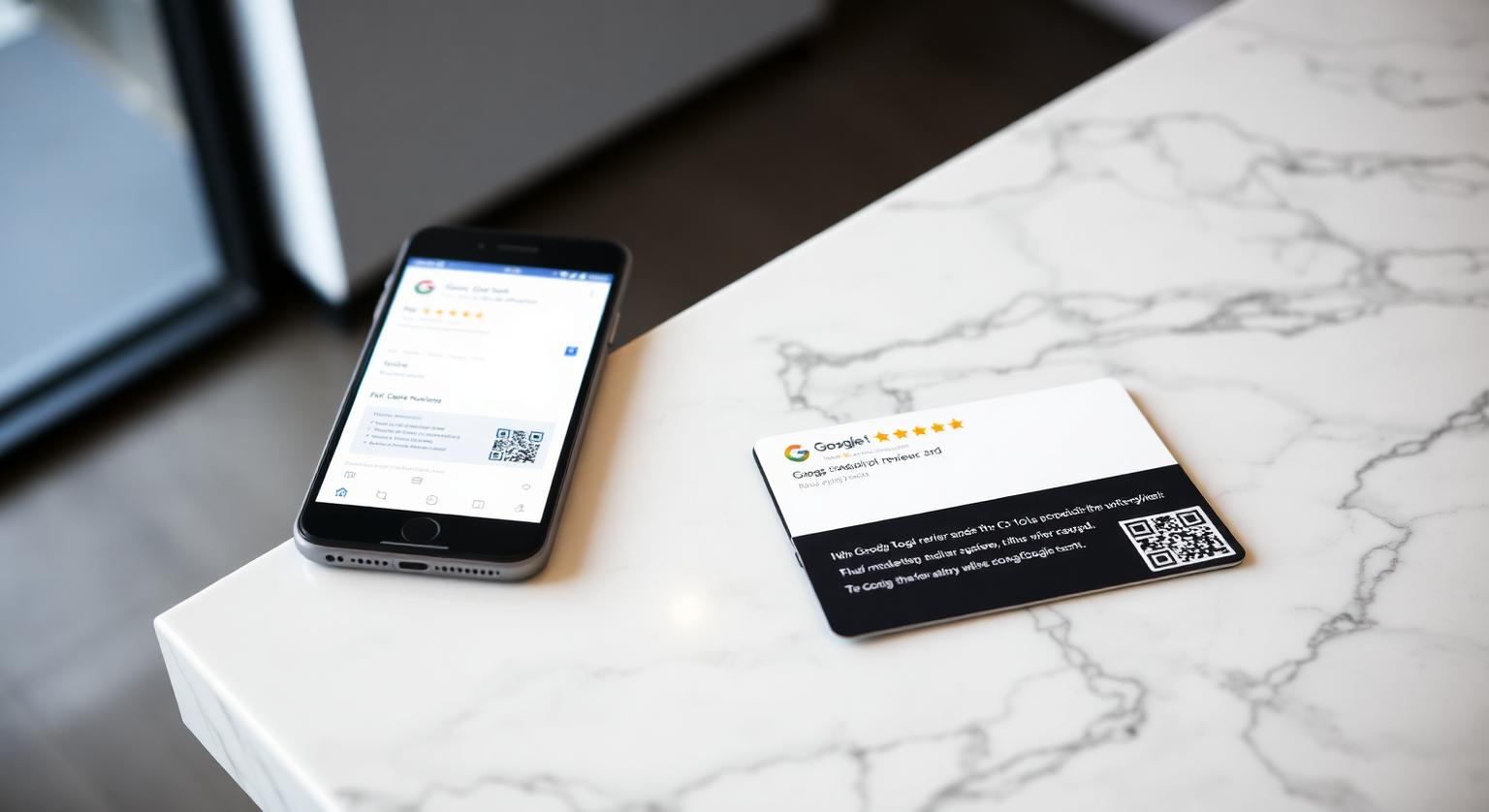
If you've ever watched ten customers walk past your billing counter without touching your printed QR card, this guide is for you. We've shipped over 4,000 designed NFC Google Review Cards to Indian businesses across Mumbai, Bengaluru, Delhi NCR, Hyderabad and Pune — the patterns below are the ones that actually move the needle on Indian counters in 2026.
The best Google Review Card designs for Indian businesses in 2026 are not the most decorative — they're the ones a customer understands in under three seconds at a busy billing counter. After analysing tap-rate data from thousands of Indian businesses across restaurants, salons, clinics, kirana-style retail, gyms and home-service teams in Mumbai, Bengaluru, Delhi NCR, Hyderabad, Pune, Chennai and tier-2 cities, a clear pattern emerges: the highest-converting NFC Google Review Cards combine a familiar visual (the Google ‘G’), a one-line CTA in English, and a price point Indian SMBs can actually justify. Design is no longer cosmetic — it is the single biggest lever between many and many review conversion rate.
Why Card Design Now Drives Indian Review Conversion
Years of UPI scanning, Paytm and PhonePe prompts have trained Indian customers to look for one thing on a counter: the Google ‘G’ or QR-style visual. A premium PVC or metal NFC Google Review Card with a one-second value prop gets picked up, tapped and converted. A flimsy local-printed card with a generic line gets ignored next to the GPay sticker.
What separates a high-converting Indian card from a forgettable one:
- A single CTA in English — "Tap Here to Leave a Google Review" beats clever copy on Indian counters
- Google's 4-colour bar or ‘G’ logo at the top — the single highest-converting element in Indian stores
- Optional Hindi or regional line below the English CTA for tier-2/tier-3 cities
- Premium material (matte PVC, brushed metal, wood-grain) signals the business itself is premium
- Dual NFC + QR — iPhone users tap, the many older Android users in India scan the QR
Top 7 Google Review Card Designs Winning in India in 2026
These seven design patterns came up again and again in the highest-performing Indian accounts. Each one is built around how Indian customers behave at the billing counter — what they do while waiting for the UPI ‘success’ chime.
Matte Black + Gold Accent — premium services. Aesthetic clinics in Bandra and Indiranagar, designer salons, chartered accountants, lawyers, wealth advisors. Pairs with a ₹999–₹1,799 price point and fits a glass-top reception.
Crisp White + Google-Blue — Udipi restaurants, biryani houses, cafés, bakeries, sweet shops, QSRs. The bright white reads from across a Mumbai or Hyderabad billing counter, and the Google-blue CTA matches the screen customers land on.
Wood-Grain with Engraved Logo — boutique homestays in Goa and Coorg, heritage hotels in Jaipur and Udaipur, organic cafés, farm-to-table restaurants. Doubles as decor and gets photographed for Instagram.
Brushed Metal Dual-Mode — AC repair technicians, plumbers, electricians, RO service teams, pest control, packers & movers. Survives a service-van glove box, looks credible to a Bengaluru flat owner at the door.
Holographic Iridescent — gyms, personal trainers, nail studios, makeup artists, tattoo studios, slimming centres. Catches mall lighting and photographs well for staff stories.
Pastel + Owner Photo — paediatric clinics, kids' salons, daycare centres, family restaurants, gynaecology clinics. The face turns a transaction into a relationship and lifts taps by many in Indian tests.
Industrial Black + Loyalty QR — chai tapris, juice bars, cloud kitchens, tiffin services. NFC drives the Google review, the secondary QR opens a digital loyalty card or WhatsApp catalogue.
Counter test for any Indian business: hand the card to ten customers without explaining. If at least seven understand what to do within three seconds, the design is working. If fewer, simplify the CTA before reprinting — Indian customers often won't ask staff for clarification.
Material, Finish & Indian Pricing Benchmarks (2026)
Indian SMB owners want to know two things before ordering: what material lasts in Indian humidity and monsoon, and what should this actually cost. These are the 2026 India benchmarks based on real reorder data across single-outlet restaurants, multi-branch salon chains and home-service teams.
For most Indian single-outlet businesses, 2–4 NFC Google Review Cards at ₹699–₹1,299 each is the sweet spot — one at the billing counter, one at the reception, one or two backups. Multi-branch chains (5+ outlets across Delhi NCR, MMR or Bengaluru) usually move to a 10-pack at ₹499 per card and brand them in-house.
Card Design vs Other Review Tools — What Converts in India
- Branded NFC Google Review Card — many conversion · ideal for in-person billing-counter handoff
- Google Review Stand on a counter — many conversion · best for high-footfall restaurants and salons
- Wall-mounted Google Review Plaque — passive social proof, ~many conversion when paired with QR
- Review Sticker on the entrance door — many conversion · works for kirana-style retail and mall outlets
- WhatsApp review links — many conversion · slow, often ignored among 50+ daily messages
Design Mistakes That Quietly Kill Indian Conversion
- Two CTAs on one card — "Follow us on Instagram AND leave a Google review" splits attention and tanks tap-rate
- Offering a discount, free dessert or cashback for a review — violates Google's policy and India's Consumer Protection (E-Commerce) Rules 2020
- Tiny QR codes under 2cm — fail to scan reliably under restaurant or salon lighting
- Generic stock images instead of your own branding — feels like a pamphlet and gets ignored
- Cheap sub-₹500 cards from local printers with no-name chips — failure rate above many within 6 months of Indian humidity
How to Design Your Own Indian Google Review Card in 2026
Pick one clear call to action, such as "Tap Here to Leave a Google Review", and keep the wording plain rather than clever.
Match the card to your storefront — same primary colour, same font as your menu or signboard.
Add a face. Owner, head chef, lead stylist, clinic founder — anything human and local.
Choose dual NFC + QR. Newer iPhones and Androids tap, older Indian Android users scan. No customer is excluded.
Order 2–4 cards for a single outlet, or 10+ for multi-branch Indian chains.
Place at every customer goodbye point — billing counter, reception, mirror station, service desk.
Indian Industries Where Design Matters Most Right Now
- Restaurants, biryani houses, cafés, bakeries, sweet shops, cloud kitchens — billing-counter handoff
- Salons, barbershops, nail studios, aesthetic clinics, tattoo studios — reception handoff
- Dental clinics, physios, IVF centres, paediatricians, dermatologists — front-desk handoff at billing
- Real-estate agents, CAs, lawyers, insurance advisors — at deal closure or final consultation
- AC repair, plumbers, electricians, RO service, pest control, packers & movers — at job completion at the customer's flat
- Car detailing, MUV service centres, two-wheeler workshops — at the service desk
- Boutique homestays, heritage hotels, Airbnb hosts, vineyards in Nashik — at checkout or in-room placement
A designed NFC Google Review Card is easier to notice and use than a plain photocopied QR sheet, which can help more customers actually complete the tap — though results depend on staff prompts and footfall.
What's Changing in Indian Review Card Design for 2026
Three shifts are reshaping the Indian market this year. First, Google's MUVERA update and AI Overviews mean recent, specific reviews mentioning Indian cities and services now weigh more heavily for Map Pack visibility. Second, Indian consumer expectation has caught up with UPI and Apple Pay polish — flimsy cards now feel out of place next to a sleek Pine Labs or Mosambee POS. Third, multi-branch Indian chains (across MMR, NCR, Bengaluru) are standardising card design across outlets as a brand asset rather than a one-off purchase.
Order, Place, Measure — The 30-Day India Playbook
Week 1: Order 2–4 designed NFC Google Review Cards matched to your storefront colours.
Week 2: Place at every customer goodbye point and train each shift to hand one over with one English line.
Week 3: Track new Google reviews per day in your Google Business Profile dashboard.
Week 4: Compare monthly review count to the previous 30 days to see whether the new card and prompt changed your review flow.
Pair the right NFC Google Review Cards with a Google Review Stand at high-footfall counters and a Google Review Plaque on the wall as passive social proof — the three together compound into a complete in-store review system that runs without staff effort.
Final Word for Indian Business Owners
The best Google Review Card design for your Indian business in 2026 is the one your customers actually pick up and tap. Pick a clean English CTA, match your storefront, add a human face, choose dual NFC + QR, and budget ₹700–₹1,500 per card. That's the entire formula — a one-time purchase rather than an ongoing subscription.
❓ Frequently Asked Questions
What is the best Google Review Card design for an Indian small business in 2026?
Matte black or crisp white PVC with a single "Tap Here to Leave a Google Review" CTA in English, your storefront brand colour, dual NFC + QR, and a real face (owner, head chef, lead stylist). This converts many asked Indian customers at a ₹699–₹1,299 price point.
How much does a quality NFC Google Review Card cost in India in 2026?
Expect ₹699–₹1,299 per matte PVC card, ₹899–₹1,499 for holographic, and ₹1,499–₹2,499 for brushed metal. Multi-branch 10-packs average ₹499 per card. Anything under ₹500 typically uses no-name chips with many failure rate inside six months of Indian humidity.
Are NFC Google Review Cards legal in India under the 2020 Consumer Protection (E-Commerce) Rules?
Yes — as long as you do not incentivise the review. Offering discounts, free items or cashback for a review violates both Google's policy and India's Consumer Protection (E-Commerce) Rules 2020. A plain NFC Google Review Card that simply makes leaving an honest review easier is fully compliant.
Which Indian industries benefit most from designed Google Review Cards?
Restaurants, cafés, salons, aesthetic and dental clinics, AC/plumbing/RO service teams, real-estate agents and boutique homestays tend to benefit most, since these businesses see customers in person at a clear payment or checkout moment where a card can be handed over.
Do Google Review Cards work with all Indian smartphones?
Every iPhone from iPhone 7 onward supports NFC tap-to-review natively. About many Indian Android phones in active use support NFC; the remaining many (older Redmi, Realme and entry models) use the printed QR code backup on every quality card, so no Indian customer is excluded.
How many Google Review Cards does a typical Indian outlet need?
Most single-outlet Indian businesses do best with 2–4 cards — one at the billing counter, one at reception, and one or two backups. Multi-branch Indian chains usually scale to a 10-pack at ₹499 per card.
Does Google Review Card design really change review volume?
Yes — significantly. Well-designed cards with a clear CTA typically lift tap-to-review conversion by 2–4x versus generic or cluttered cards. The design closes the gap between owning a card and actually collecting reviews.
Is minimalist design better than heavily branded design?
In most verticals, yes. Minimalist layouts reduce decision fatigue and make the action obvious. Strong-brand businesses (salons, independent cafes, boutique hotels) can still add their logo tastefully without hurting conversion.
Should I include star icons on the card?
Yes, as visual cues only. Stars instantly communicate 'reviews' without words. Never ask for a specific star rating — that constitutes review gating and violates Google's policies in every region, including the US, UK, EU, and India.
Should the card explicitly mention Google?
Absolutely. Clarity beats subtlety. Customers want to know where their review is going. Mentioning Google removes hesitation and dramatically increases tap-through.
Do I still need a QR code if my card has NFC?
Yes, as a fallback. NFC handles most modern phones, but a backup QR code captures older devices and hesitant tappers, ensuring you never lose a review opportunity.
What card stock works best for NFC Google Review Cards?
600gsm matte or soft-touch stock is the sweet spot. It feels premium, photographs well for social proof, and protects the NFC chip in high-traffic environments like restaurants and salons.
Can the same card design work across the US, UK, Canada, Australia, UAE, and India?
Yes, as long as the CTA is in plain English and the QR/NFC link points to your localized Google Business Profile. Multilingual businesses in the UAE and India often add a second-language line below the main CTA.
Related Guides & Tools
Hand-picked next reads for Indian small businesses growing their Google reviews.
Explore Our Products
Google Review Card
NFC tap cards that take customers straight to your Google review page.
Google Review Stand
Countertop stands perfect for restaurants, salons, and reception desks.
Google Review Plaque
Wall-mounted plaques that collect reviews in high-traffic areas.
Google Review Stickers
Peel-and-stick NFC stickers for windows, doors, and counters.
Google Review Keychains
Portable keychains your team can carry to collect reviews anywhere.
NFC Wristband
Wearable NFC wristbands for events, trade shows, and on-the-go reviews.
Ready to Get More Google Reviews?
Start collecting reviews instantly with NFC Google Review Cards.
Shop NowRelated Articles
NFC Review Cards vs QR Review Cards – Which Gets More Reviews?
We analysed real conversion data from thousands of businesses. The results are decisive — but the smartest approach might surprise you.
What Is a Google Review Card? (Full Guide + How It Works)
Everything you need to know about the physical card that's helping thousands of businesses collect more Google Reviews — faster and easier than ever.