What Actually Affects Google Review Conversion by Industry (U.S. %currentyear%)
There's no universal formula for how many customers leave a Google review — but placement, timing, and friction consistently make the difference across every U.S. industry. Here's what actually matters.
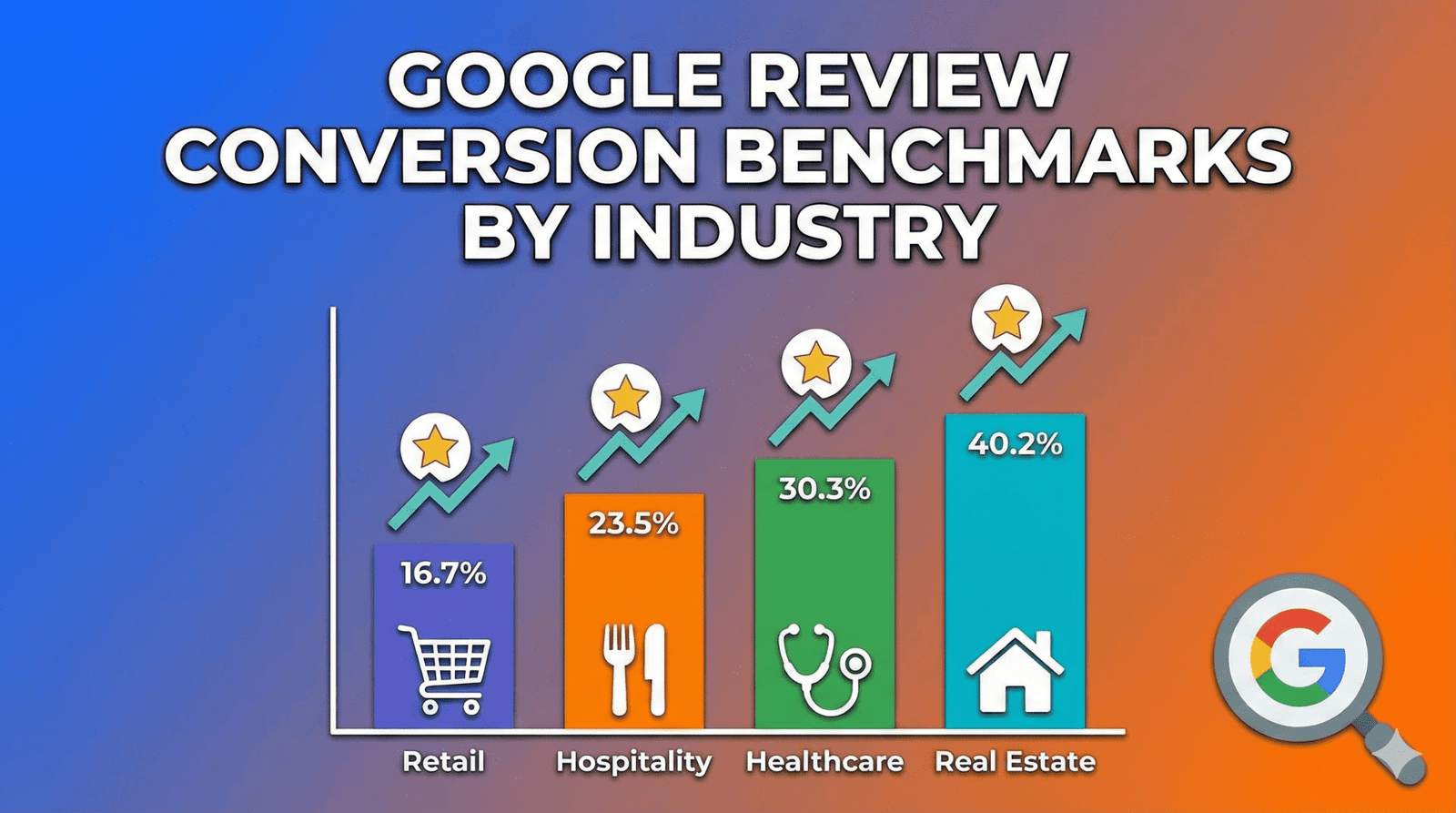
Every local business owner in the United States eventually asks the same question: why do some customers leave a Google review without being asked, while most never think about it again after paying? There's no fixed number that applies to every business, and treating review collection as a numbers game misses the point. What actually determines whether a happy customer turns into a public review comes down to a handful of practical factors: how and when you ask, how much effort the customer has to put in, and whether the moment you pick for the ask matches how the customer is actually feeling. This guide walks through those factors industry by industry, without pretending to know exact rates that no two businesses will ever share.
Why There's No Single Review Conversion Number
Review conversion is simply the share of customers who leave a Google review after doing business with you. It's a useful number to track for your own business over time, but comparing it across industries — or even across two businesses in the same industry — is misleading. A dental practice, a food truck, and a real estate agent all have completely different customer relationships, different transaction sizes, and different emotional stakes. Publishing a table of 'benchmark' percentages for each industry implies a precision that doesn't exist in practice, because the real drivers of conversion are operational choices, not industry averages.
That said, most businesses that never track this number at all are missing something important: whether their current way of asking for reviews is working, or quietly failing. The fix isn't chasing an industry average — it's understanding the handful of variables that reliably make an ask more or less likely to succeed.
A simple check: divide last month's new Google reviews by last month's unique customers. If that ratio feels low compared to how many customers seemed satisfied, the ask process — not the customer experience — is usually the problem.
The Variables That Actually Move the Needle
Across every industry, the same few factors show up again and again when a business improves how often customers leave reviews.
- Timing — asking near the peak of the customer's positive emotion, rather than hours or days later, when the moment has faded
- Who asks — a direct, in-person request from a technician, stylist, server, or agent tends to land better than an automated message
- Friction — the fewer steps between deciding to leave a review and actually posting it, the more people follow through
- Consistency — asking every customer the same way, every time, rather than only when someone remembers
- Method — a physical prompt like an NFC card or a printed sign performs differently than a link buried in a receipt email, simply because it's easier to act on immediately
None of these guarantee a specific result, and none of them are a substitute for actually providing a service worth reviewing. But businesses that pay attention to these variables consistently report an easier time collecting reviews than those that treat it as an afterthought.
Home Services: HVAC, Plumbing, Electrical, Roofing
Home services tend to have an advantage here because the transaction is personal and often tied to real relief — an AC that's finally fixed on a brutal summer day, a leak that's finally stopped. That gratitude is real, but it fades fast once the technician leaves the driveway. The businesses that do well ask for the review on the spot, while the customer is still standing there feeling relieved, rather than relying on a follow-up email or text sent later.
Dental, Medical, and Aesthetic Clinics
Healthcare-related reviews tend to be detailed and trust-driven, because patients researching a provider read carefully before booking. The best moment to ask is right at checkout, immediately after a positive appointment, ideally with a short, natural prompt from front-desk staff rather than a generic follow-up message sent days later, when the visit is no longer top of mind.
Restaurants, Cafés, and Food Service
Restaurant customers move fast — they pay and leave, and there's rarely a natural pause to ask for a review. That's why the ask has to happen at the table or the register, not through a QR code on a receipt that gets glanced at once the customer is already walking to their car. Volume helps offset a lower response rate here, but the underlying challenge is the same: less time, less friction tolerance, and a narrower emotional window than in other industries.
Salons, Barbershops, and Spas
Personal care services have a distinct advantage: the moment the client sees the finished result in the mirror is a genuine high point. Asking right then — before the client moves on to paying and thinking about a tip — tends to work far better than asking at checkout, when the emotional peak has already passed.
Gyms, Personal Trainers, and Wellness Studios
This industry benefits from milestone moments — a personal best, finishing a challenge, hitting a goal weight. Asking right after one of those moments tends to land better than asking during a routine check-in. Large gyms with anonymous entry have a harder time here simply because there's no natural, personal moment to anchor the request.
Retail Stores and Boutiques
Retail purchases are often satisfying but not particularly emotional, which makes reviews harder to come by. The businesses that do better tend to ask at a genuinely positive moment — after a helpful fitting, a good recommendation, or an easy return — rather than at every transaction regardless of how it went.
Hotels, Motels, and Short-Term Rentals
Stays generate detailed reviews when the ask is timed well — at checkout, while the trip is still fresh, rather than in a follow-up email sent a week later once the experience has faded. In-person prompts at the front desk or a card left in the room tend to outperform delayed automated messages.
Real Estate Agents and Mortgage Brokers
Buying or selling a home is a major life event, and clients are often genuinely willing to share their experience. The best time to ask is at or right after closing, while the moment is still fresh — not two weeks later in a generic follow-up email that arrives after the excitement has settled.
Auto Repair, Detailing, and Car Dealerships
A repair shop that solves a frustrating, hard-to-diagnose problem earns real goodwill. Handing the customer a simple way to leave a review right when they pick up their keys captures that goodwill far more reliably than a receipt QR code or a follow-up text sent after the customer has already driven off and moved on with their day.
What Separates Businesses That Collect Reviews Consistently
Across every industry, the businesses that do well at this share a handful of habits, regardless of what city or state they're in.
- They ask in person, at the moment the customer feels best about the experience — not later by email or text
- They reduce friction by using tap-to-review tools like NFC cards instead of relying only on QR codes or emailed links
- They train every frontline employee to use the same short, natural request
- They respond to reviews, including critical ones, in a timely and professional way
Businesses that struggle usually share the opposite habits: they ask too late, they only ask by email, they ask inconsistently, or they make the customer hunt for the review link. Fixing those habits is a matter of process, not budget.
How NFC Review Cards Help
NFC Google Review Cards work by removing steps. Instead of opening an email, finding a link, or scanning a QR code and waiting for a page to load, a customer taps their phone against the card and the Google review form opens directly. That doesn't change how a customer feels about your business, but it does remove a common reason a customer who was willing to leave a review simply never gets around to it.
Review Behavior Varies by Region — and That's Fine
Customer behavior isn't identical everywhere in the U.S. In some dense metro areas, customers write longer, more detailed reviews but are also more skeptical of an obvious ask. In smaller markets, customers may be less likely to leave a review unprompted but respond well to a friendly, direct request from staff. There's no need to chase a specific regional pattern — the fundamentals (timing, friction, consistency) matter everywhere, even if the exact response varies from one community to the next.
The FTC and Google Compliance Line
Whatever approach you take, it has to stay within the rules. The FTC's rules on reviews and testimonials make it illegal for U.S. businesses to buy reviews, offer incentives for reviews, suppress negative reviews, or use review gating — the practice of only asking customers you believe are happy. Google's own policies align closely with the FTC's and can result in a Business Profile being suspended if violated.
The safe and sustainable approach is to ask every customer the same way, make it as easy as possible to follow through, and never offer anything in exchange for a review. That approach also tends to produce more honest, useful reviews for future customers reading them.
A Simple Way to Improve Your Process
Step 1 — Look at how many Google reviews you've received recently compared to how many customers you served, just to get a sense of where you stand today.
Step 2 — Identify the moment in your customer journey when satisfaction is highest, and place your review request there instead of somewhere more convenient for you.
Step 3 — Write a short, natural request and have every customer-facing employee use the same one.
Step 4 — Make responding to reviews part of your routine, and keep the request process consistent instead of ad hoc.
The Bottom Line for U.S. Business Owners
There's no reliable industry benchmark that tells you exactly how many of your customers should be leaving Google reviews — anyone claiming otherwise is presenting invented precision. What you can control is how and when you ask, how much friction stands between a satisfied customer and a published review, and whether you ask consistently instead of only when it crosses your mind. Focus on those, keep your process compliant with FTC and Google guidelines, and the reviews will follow at whatever pace fits your business.
❓ Frequently Asked Questions
Is there a standard 'good' Google review conversion rate for U.S. small businesses?
Not really — it varies too much by industry, transaction type, and how the business asks for reviews to make a single number meaningful. It's more useful to track your own rate over time and focus on improving the timing and ease of your ask than to compare yourself to an industry average.
How do I calculate my business's Google review conversion rate?
Divide the number of Google reviews you received in a given period by the number of unique paying customers or transactions in that same period. Tracking this over time tells you whether changes to your process are helping, even without a benchmark to compare against.
Which types of U.S. businesses tend to have an easier time getting reviews?
Businesses with high-trust or emotionally significant transactions — home repairs, real estate closings, med spa visits, milestone fitness moments — tend to have an easier time because customers are already in a reflective, grateful state. That's an advantage of the transaction type, not a fixed rate.
Do NFC Google Review Cards actually help increase reviews?
They help primarily by removing friction — a customer taps their phone and the review form opens immediately, instead of needing to find an email, scan a QR code, or search for your business. Removing that friction generally makes it easier for a customer who was already willing to leave a review to follow through.
Is it legal to ask every U.S. customer for a Google review?
Yes. Asking every customer for an honest review is fully legal and encouraged by Google. What's illegal under FTC rules is offering incentives, only asking customers you expect to be happy (review gating), buying reviews, or suppressing negative feedback.
Why do some industries seem to get fewer reviews than others?
Transactions that are fast, low-emotion, or anonymous — like a quick retail purchase or a fast-casual meal — naturally produce fewer unprompted reviews than transactions tied to relief, milestones, or major decisions. Businesses in these categories often rely more on consistent, low-friction asks to make up the difference.
How quickly will I notice a change if I improve my review-request process?
It varies by business and customer volume, so there's no fixed timeline. What matters more than speed is consistency — asking every customer the same way, at the right moment, tends to produce a steady improvement over time rather than an overnight jump.
Should U.S. businesses focus on Google reviews or Yelp reviews?
Google is generally the priority for most U.S. local businesses because of how central Google Search and Maps are to local discovery. Yelp still matters in certain cities and categories, so it's worth maintaining, but most businesses get more practical value from focusing their review-collection effort on Google.
Related Guides & Tools
Hand-picked next reads for US small businesses growing their Google reviews.
Explore Our Products
Google Review Card
NFC tap cards that take customers straight to your Google review page.
Google Review Stand
Countertop stands perfect for restaurants, salons, and reception desks.
Google Review Plaque
Wall-mounted plaques that collect reviews in high-traffic areas.
Google Review Stickers
Peel-and-stick NFC stickers for windows, doors, and counters.
Google Review Keychains
Portable keychains your team can carry to collect reviews anywhere.
NFC Wristband
Wearable NFC wristbands for events, trade shows, and on-the-go reviews.
Make Leaving a Review Effortless
Order NFC Google Review Cards built for U.S. businesses. Flat $6.99 tracked delivery.
Shop NFC Review CardsRelated Articles
The ROI of Improving Google Reviews for Local Businesses
You're spending thousands on ads and SEO. Meanwhile, the highest-ROI growth lever might be sitting right in front of you — your Google Reviews.
How Many Google Reviews Do You Need to Rank Higher?
There's no magic number — but there are clear benchmarks by industry and competition level. Here's where you need to be.