Review Cards vs Review Stands: Which Works Best in Indian Businesses?
Key facts
- Question answered
- Card or counter stand for your business
- Card
- Handheld, moves with staff, credit-card size
- Stand
- Stays on a counter, visible to every customer
- Both use
- NFC tap plus a printed QR code
- Price from
- Cards $9.99, stands $29.99 (US storefront)
Cards work great when handed to customers. Stands work great on counters. Here's which one suits your specific Indian business — and why most people pick wrong.
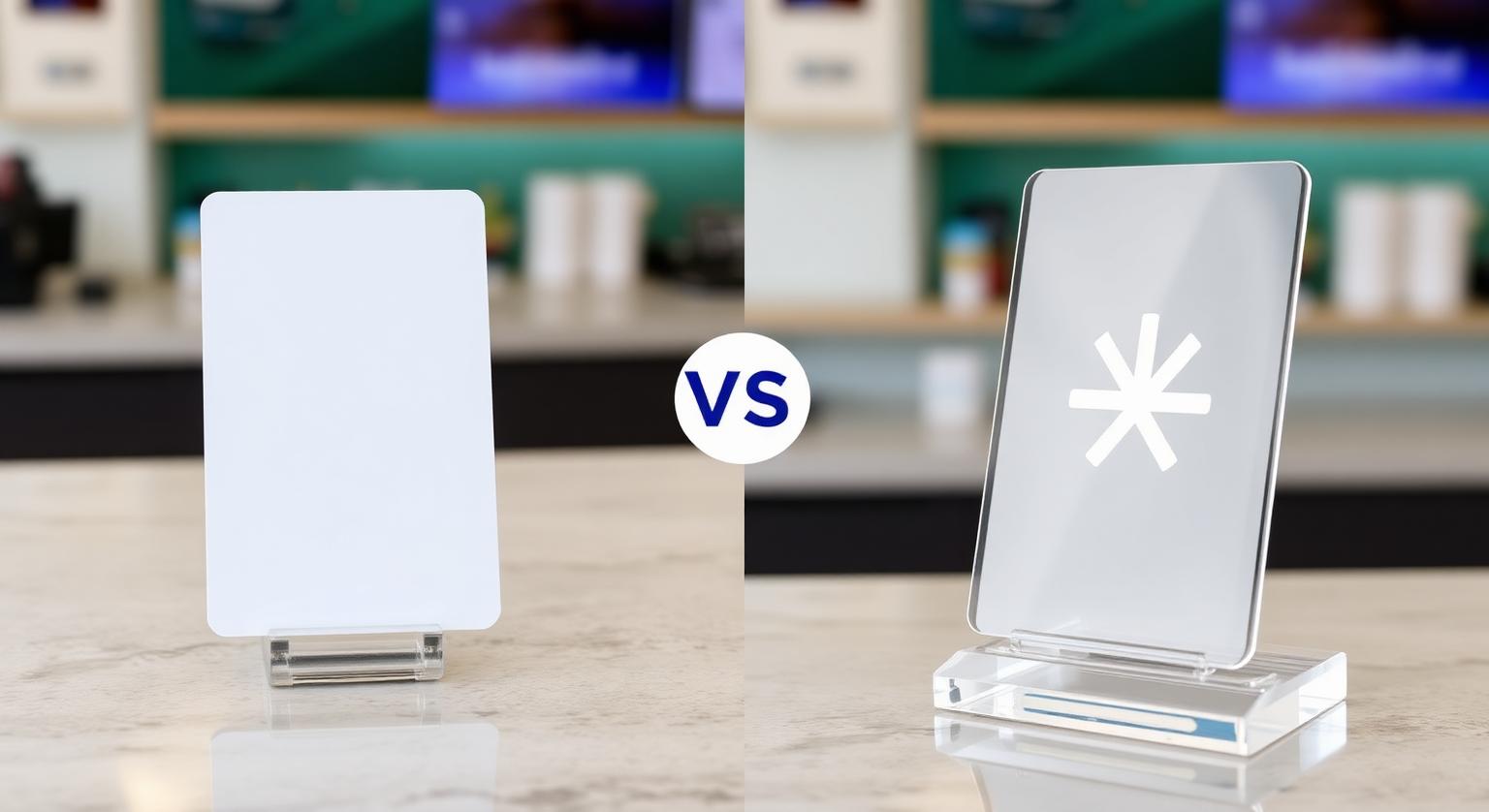
Cards or stands? It's the biggest question we get from Indian business owners and the answer isn't ‘both’. The right choice depends on your customer journey — a takeaway café and a sit-down restaurant need completely different solutions.
‘Cards or stands?’ is the first question we get from Indian business owners. The answer isn't ‘both’ — that's lazy advice. The right choice depends on your customer journey, your average bill size, and whether your customer is sitting, standing, or walking out. Pick wrong and the tool sits unused. Pick right and reviews compound.
When Google Review Cards Win
Cards win when your staff physically hands them to the customer. The act of handing the card creates a small social contract — the customer feels personally addressed, not advertised at. Cards are ideal for sit-down restaurants (clipped to the bill), salons (handed at the mirror moment), clinics (handed with the prescription), and any business where there's a clear one-on-one moment between staff and customer.
When Google Review Stands Win
Stands win when customers come to a fixed point — the billing counter, the reception desk, the takeaway window. Stands work passively: the customer sees it while waiting, taps without being asked. Stands are ideal for QSR/takeaway, retail shops, kirana stores, pharmacies, sweet shops, and high-volume counters where staff don't have time to hand cards individually.
Quick Decision Matrix for Indian Businesses
Real Performance Numbers from Indian Businesses
When You Genuinely Need Both
Hybrid businesses do need both. Hotels need a card on the bedside table AND a stand at reception. Salons with a takeaway product counter need cards at chairs AND a stand at the product counter. Multi-format restaurants (dine-in + takeaway) need cards at tables AND a stand at the takeaway window. The rule: every distinct customer flow gets its own tool.
Cost Comparison in Indian Pricing
- Google Review Card (NFC + QR backup): ₹800–₹1,500 per card
- Google Review Stand (acrylic, premium): ₹1,800–₹3,500 per stand
- Google Review Plaque (wall-mounted): ₹2,500–₹5,000 per plaque
- Multi-Review Card (Google + Zomato + Justdial): ₹1,200–₹2,000
- NFC Sticker (for delivery bags / windows): ₹150–₹400 per sticker
- Most Indian businesses spend under ₹5,000 total for a complete setup
Don't over-buy. Most single-location Indian businesses need 1 stand + 2–3 cards. Anything more is just extra inventory that won't change conversion.
Common Indian Mistakes When Choosing Tools
- Buying 10 cards because they're cheaper — most sit unused
- Placing a stand at the entrance instead of at the billing counter — entrances are not review zones
- Skipping the QR backup on cards — loses many customers with non-NFC phones
- Choosing acrylic stands that yellow in 6 months under Indian sunlight — invest in UV-stable acrylic
- Putting the stand behind the cashier's screen where customers can't see it
- Buying cheap ₹100 NFC cards that fail after 2 months — the chip cost is the same; you're paying for the design and finish
❓ Frequently Asked Questions
Can I use a card AND a stand in the same Indian shop?
Yes — and for most multi-flow Indian businesses (hotels, large restaurants, multi-chair salons), you should. Different customer moments deserve different tools. Just don't buy more than you'll actively use.
Which is more durable in Indian conditions — card or stand?
Quality stands (UV-stable acrylic, weighted base) last 3+ years through monsoon, summer heat, and daily wiping. Quality NFC cards (soft-touch finish, NTAG 215/216 chip) last 2+ years. Cheap versions of either fail within months.
Do stands convert as well as cards?
It depends on the business type. For sit-down hospitality, cards tend to convert better. For high-traffic counters (QSR, retail, pharmacy), stands tend to convert better. The customer journey is what decides — not the tool itself.
Where exactly should I place the stand in an Indian shop?
Eye level for a standing customer, within 30cm of the UPI sound box, on the cashier's right side (where most Indians instinctively look). Wrong placement (too low, hidden, near exit) kills conversion.
Can I get a stand in my Indian brand colours?
Yes — most quality suppliers offer custom branding. But the Google ‘G’ logo and the ‘Tap to Review’ text should always remain prominent. Subtle brand colour accents help; overpowering the Google branding hurts conversion.
Which converts better?
Review Cards tend to convert better per individual interaction because of the personal ask and precise timing, though we don't have a controlled study to cite an exact figure. Stands can generate more total reviews in high-traffic locations because they work continuously without any staff effort.
Which should I buy first?
Start with NFC Google Review Cards — the personal ask usually gets a habit of collecting reviews going fastest. Once your team is used to asking, add a stand to capture the passive opportunities you're currently missing.
Related Guides & Tools
Hand-picked next reads for Indian small businesses growing their Google reviews.
Explore Our Products
Google Review Card
NFC tap cards that take customers straight to your Google review page.
Google Review Stand
Countertop stands perfect for restaurants, salons, and reception desks.
Google Review Plaque
Wall-mounted plaques that collect reviews in high-traffic areas.
Google Review Stickers
Peel-and-stick NFC stickers for windows, doors, and counters.
Google Review Keychains
Portable keychains your team can carry to collect reviews anywhere.
NFC Wristband
Wearable NFC wristbands for events, trade shows, and on-the-go reviews.
Ready to Get More Google Reviews?
Start collecting reviews instantly with NFC Google Review Cards.
Shop NowRelated Articles
The Best Tools for Collecting Google Reviews in 2026
NFC cards, stands, plaques, stickers, wristbands — which review tools actually deliver results, and which are just novelty?
Google Review Stand Placement: 5 Spots That Triple Reviews
Most stands fail because of where they sit, not how they look. Here's the placement playbook that turns a countertop Google Review Stand into a 24/7 review-collection machine for restaurants, salons, clinics, and retail.