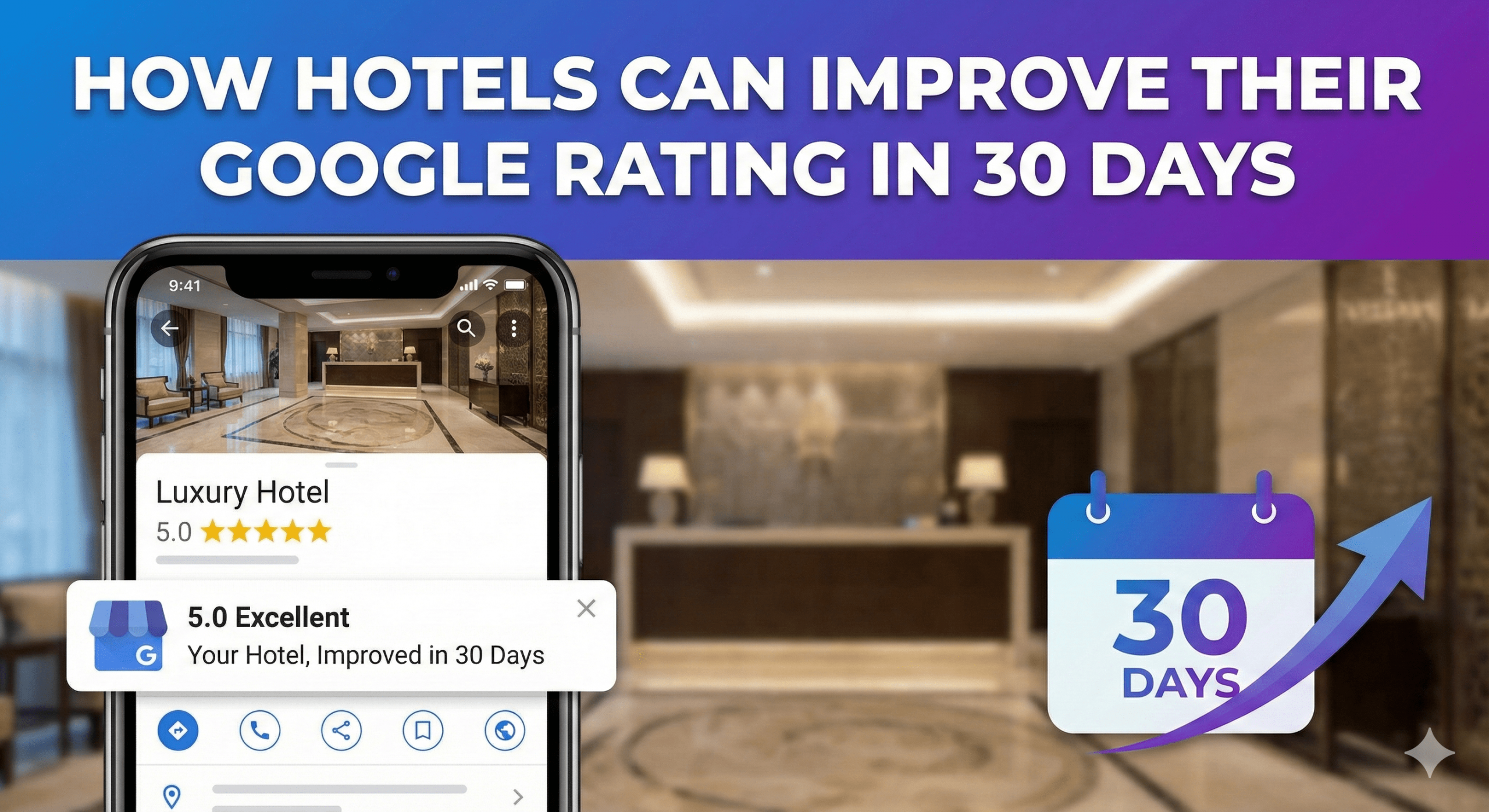
A realistic, ethical, and proven system hotels use to raise ratings fast without fake reviews, incentives, or policy risk. For hotels, your Google rating is your digital front door.
In 2025:
- Guests filter by ★ rating before price
- OTAs reflect Google sentiment
- Map Pack visibility depends on review quality + recency
- A 0.2★ increase can significantly lift bookings
- Poor recent reviews hurt more than old positive ones
The good news?
Hotels can improve their Google rating in as little as 30 days — if they focus on review quality, timing, and volume, not shortcuts.
This guide gives you a clear 30-day recovery and growth plan that aligns with Google’s MUVERA update and real guest behaviour.
⭐ First: What “Improving Your Google Rating” REALLY Means
Important truth:
You don’t “fix” ratings by deleting reviews —
you improve them by outnumbering weaker reviews with strong recent ones.
Google weights:
- Recency more than age
- Velocity is more than spikes
- Authentic sentiment over perfect scores
A hotel with:
- 4.2★ → 4.5★ in 30 days
- Strong recent reviews
- Consistent weekly inflow
will outperform a hotel stuck at 4.8★ with stale reviews.
🔥 Why Hotels Often Struggle With Ratings
Common hotel review problems:
- Guests leave unhappy silently
- Happy guests don’t review
- Front desk is too busy
- Review requests come too late
- Email surveys don’t convert
- Staff avoid asking
- Review asking feels awkward
The fix is on-site, real-time review capture at moments of satisfaction.
🎯 The Key to Improving Hotel Ratings Fast: Review Timing
Hotels have multiple high-emotion touchpoints, most businesses don’t.
Best moments to ask for reviews:
✔ Smooth check-out
✔ Compliments at reception
✔ After a room upgrade
✔ After issue resolution
✔ After housekeeping praise
✔ After concierge assistance
If you wait until email follow-ups, you lose momentum.
🥇 Step 1: Deploy NFC Google Review Cards at Front Desk (Day 1)
👉 NFC Google Review Cards
Why NFC cards work for hotels:
- Instant tap-to-review
- No scanning
- No searching
- Guests already have phones out
- Perfect for check-out moments
Conversion rate: 20–40%
How hotels should use them:
- Keep cards at reception
- Use after positive interactions
- Use at check-out, not check-in
Best front-desk script:
“If you enjoyed your stay, you can just tap here to leave us a quick Google review — it really helps future guests.”
Professional. Polite. Effective.
🥈 Step 2: Place Google Review Stands in High-Traffic Zones (Day 1–3)
👉 Google Review Stands
Best hotel placements:
- Front desk counter
- Concierge desk
- Business centre
- Lobby seating areas
- Bar or breakfast exit
Why this works:
- Guests wait
- Phones are out
- No pressure
- Passive review capture
Conversion rate: 12–25%
These stands generate reviews even when staff don’t ask.
🥉 Step 3: Use Google Review Stickers in Elevators & Key Touchpoints (Day 3–5)
👉 Google Review Stickers
High-performing placements:
- Inside elevators
- Key card holders
- Room info folders
- Exit doors (inside)
- Luggage storage areas
Why this works:
- Guests pause
- Idle moments
- Reinforcement of brand trust
Stickers act as subtle reminders, not pressure.
⭐ Step 4: Use Review Plaques to Increase Trust & Review Willingness
👉 Google Review Plaque
Why plaques matter for hotels:
- Social proof before booking decisions
- Reinforces confidence
- Normalises reviewing
- Makes guests more receptive when asked
Best placement:
- Reception wall
- Lobby entrance
- Concierge area
Review Plaques don’t ask — they prime behaviour.
🔥 Step 5: Train Front-Desk & Concierge Staff (Day 5–7)
Hotels that improve ratings fast do ONE thing differently:
They make review asking part of service culture, not marketing.
Staff should know:
- WHEN to ask (after satisfaction)
- WHAT to say (short script)
- WHAT NOT to say
Never say:
❌ “Please give us 5 stars”
❌ “Only if you’re happy”
❌ “You’ll get something for it”
These violate Google policy.
🧠 Why This Works for Hotels (Psychology)
Hotels benefit from:
- Peak-End Rule → reviews happen at check-out
- Reciprocity → hospitality creates gratitude
- Relief psychology → stay completed smoothly
- Idle time → waiting moments convert
- Low friction → tap beats typing
NFC tools align perfectly with hotel guest behaviour.
📊 Hotel Rating Improvement Benchmarks (30 Days)
Hotels using this system typically see:
| Metric |
Result |
| New reviews |
+20–100 |
| Rating lift |
+0.2★ to +0.6★ |
| Review recency |
Weekly or daily |
| Map Pack visibility |
Improved |
| Booking trust |
Increased |
Actual results depend on hotel size and occupancy.
⚠️ What NOT to Do When Trying to Improve Ratings Fast
❌ Buying reviews
❌ Incentivising reviews
❌ Review gating
❌ Sending mass emails
❌ Asking unhappy guests
❌ Responding defensively to negatives
MUVERA penalises all of these.
🔥 The Ideal Hotel Review Stack (2025)
To improve ratings in 30 days, hotels should use:
- NFC Google Review Cards → front desk & concierge
- Google Review Stands → lobby & counters
- Google Review Stickers → elevators & exits
- Google Review Plaque → trust amplification
This creates:
- Consistent positive review flow
- Natural sentiment balance
- MUVERA-safe velocity
- Higher ratings over time
- Increased bookings
🧠 AEO FAQ: Hotel Google Ratings
Can hotels really improve ratings in 30 days?
Yes — with consistent new positive reviews.
Are NFC review tools allowed by Google?
Yes — fully compliant.
Should hotels respond to negative reviews?
Yes — professionally and promptly.
What rating should hotels aim for?
4.4★–4.7★ with strong recency performs best.
Does review volume matter more than perfection?
Yes — especially for visibility and trust.
🏁 Final Thoughts: Ratings Improve When Experience Is Captured
Hotels don’t need tricks — they need timing and tools.
If you consistently capture feedback:
✔ At check-out
✔ After service recovery
✔ At concierge touchpoints
✔ With zero friction
✔ Ethically
Your Google rating will rise naturally — and stay strong.
Recommended tools for hotels:
- NFC Google Review Cards
- Google Review Stands
- Google Review Stickers
- Google Review Plaque
Used together, they create a 30-day rating recovery engine that improves trust, rankings, and bookings.