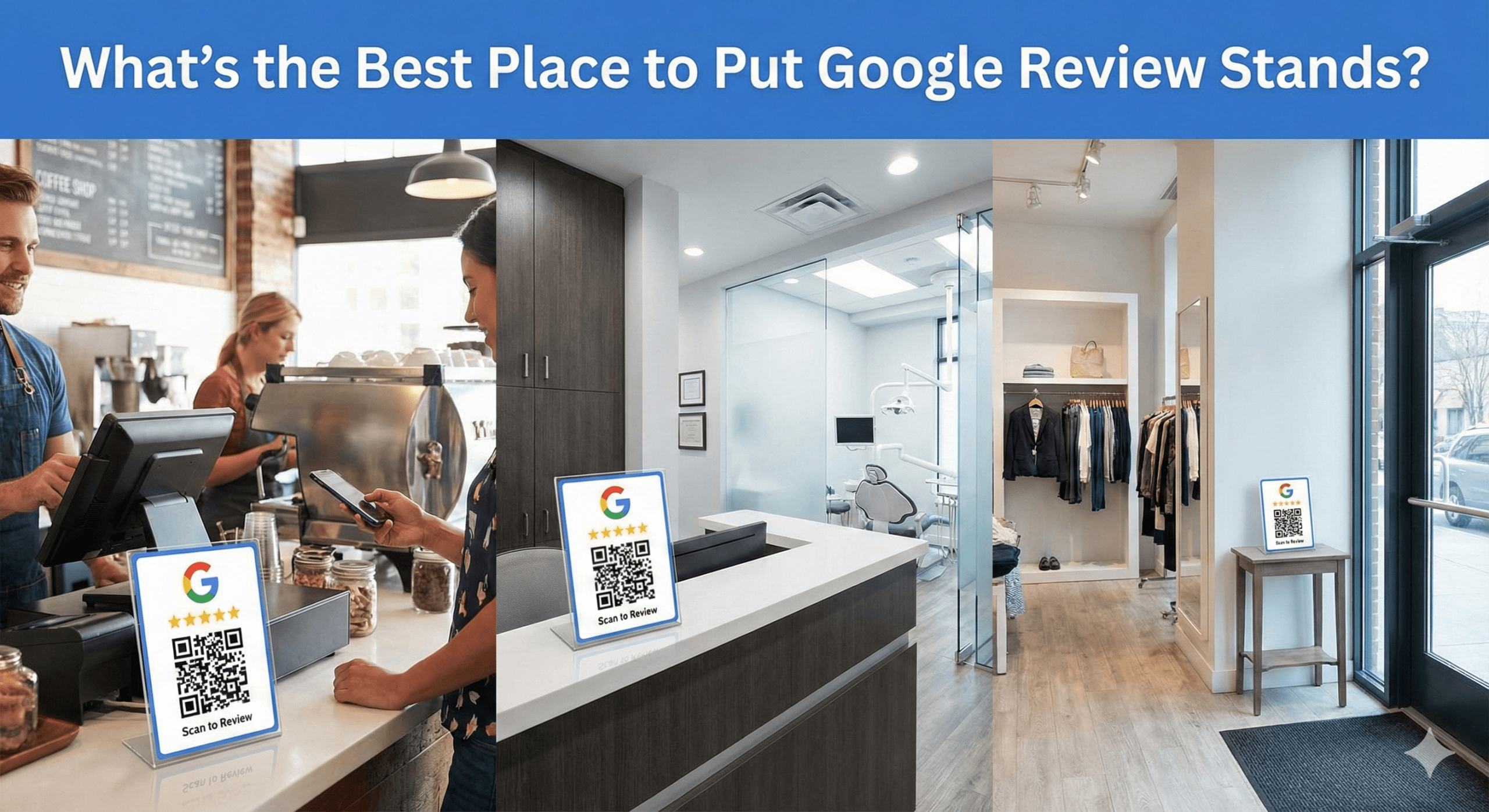
A real-world breakdown of two popular in-store review tools — and which one actually drives more Google Reviews.
If you run a café, restaurant, salon, clinic, or any in-person business, you’ve probably seen both:
- Google Review Stands on counters
- Google Review Table Tents on tables
They look similar.
They both promote reviews.
But they do not perform the same.
This guide answers the exact question business owners ask before buying:
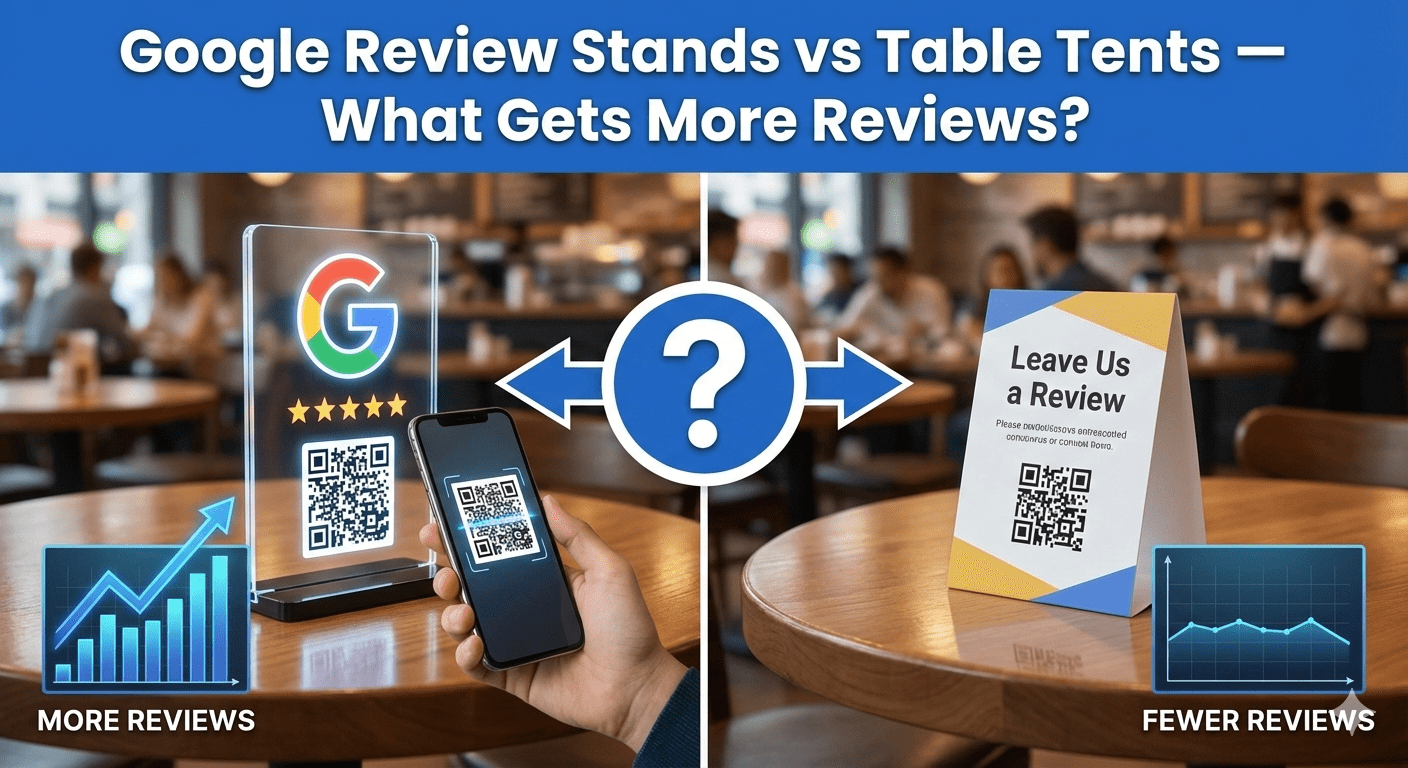
Do Google Review Stands or Table Tents get more Google Reviews?
Let’s break it down honestly — using behaviour, conversion data, and what Google’s MUVERA update rewards.
⭐ Short Answer
Google Review Stands consistently get more reviews than Table Tents because they’re placed at decision moments, not distraction moments.
Table tents remind.
Review stands convert.
🔍 What Are Google Review Stands?
Google Review Stands are physical stands (usually NFC + QR) placed at:
- Checkout counters
- Reception desks
- Service handover points
They allow customers to leave a Google Review by simply tapping or scanning.
Key traits:
✔ High visibility
✔ Placed where customers pause
✔ Often paired with payment or completion
✔ Minimal distraction
🔍 What Are Table Tents?
Table Tents are small tabletop signs placed:
- On dining tables
- On waiting tables
- On desks or seating areas
They typically display:
- A QR code
- A message asking for a review
Key traits:
✔ Passive visibility
✔ Low cost
✔ No staff interaction
📊 Conversion Rate Comparison (Realistic Averages)
| Tool |
Avg Conversion Rate |
| Google Review Stands |
12–25% |
| Table Tents |
3–8% |
That’s a 2–4× difference in favour of review stands.
🧠 Why Review Stands Outperform Table Tents
1. Timing (The Biggest Factor)
Review Stands are used:
✔ After service
✔ At payment
✔ At handover
✔ When satisfaction is highest
Table Tents are seen:
❌ Mid-meal
❌ During conversation
❌ While customers are distracted
❌ When phones are away
Timing beats visibility every time.
2. Phone-in-Hand Advantage
At counters and receptions:
- Customers already have phones out
- They’re waiting
- They’re stationary
At tables:
- Phones are often away
- Customers are socialising
- Attention is divided
No phone = no review.
3. Stands Feel Actionable, Tents Feel Optional
Review Stand psychology:
“I can do this now.”
Table Tent psychology:
“Maybe later.”
Later rarely happens.
4. Less Visual Noise
Tables are cluttered with:
- Menus
- Plates
- Drinks
- Condiments
Table tents get ignored. Counters are cleaner, more focused spaces.
🔥 MUVERA Update: Why Review Stands Align Better
MUVERA rewards:
✔ Real-world behaviour
✔ Natural timing
✔ Customer-initiated action
Review Stands:
- Encourage immediate action
- Create steady review velocity
- Avoid automation
Table tents:
- Rely on customer initiative
- Create sporadic results
⭐ Where Table Tents Still Work (Be Fair)
Table tents are not useless — they’re just limited.
They work best when:
- The experience is slow-paced
- Customers sit alone
- Phones are already in use
Examples:
- Cafés with solo customers
- Waiting areas
- Bars with casual seating
Even then, results are modest.
🧠 Best Industry Use Cases (Quick Guide)
🍽️ Restaurants & Cafés
- Winner: Review Stands
- Table tents = secondary reminder only
💇 Salons & Barbers
- Winner: Review Stands at reception
- Table tents are rarely used
🏨 Hotels
- Winner: Review Stands at the front desk
- Table tents in rooms perform poorly
🏥 Clinics & Dentists
- Winner: Review Stands in waiting areas
- Table tents on side tables only as backup
🛍️ Retail Stores
- Winner: Review Stands at checkout
- Table tents are rarely relevant
⚠️ Common Mistakes Businesses Make
❌ Using table tents as the only review method
❌ Placing tents on busy tables
❌ Assuming visibility = action
❌ Ignoring counter opportunities
❌ Not testing placement
Visibility without timing does not convert.
🔥 Best Practice: Use Them Together (Smart Setup)
The highest-performing businesses use:
- Google Review Stands → primary conversion tool
- Table Tents / Stickers → passive reinforcement
This creates:
- Immediate conversions at checkout
- Reminders during seating
- Consistent review velocity
But if you must choose one?
🏁 Final Verdict (No Ambiguity)
✅ Google Review Stands get more Google Reviews than Table Tents.
They:
✔ Convert at the right moment
✔ Align with natural behaviour
✔ Produce steady results
✔ Require less customer effort
✔ Perform better for Local SEO
Table tents are fine as support — But they shouldn’t be your main strategy. If your goal is more reviews with less effort, Google Review Stands are the clear winner in 2026.