Here is your fully written, human-first, MUVERA-aligned, AEO-ready, psychology-focused, SEO-optimised.
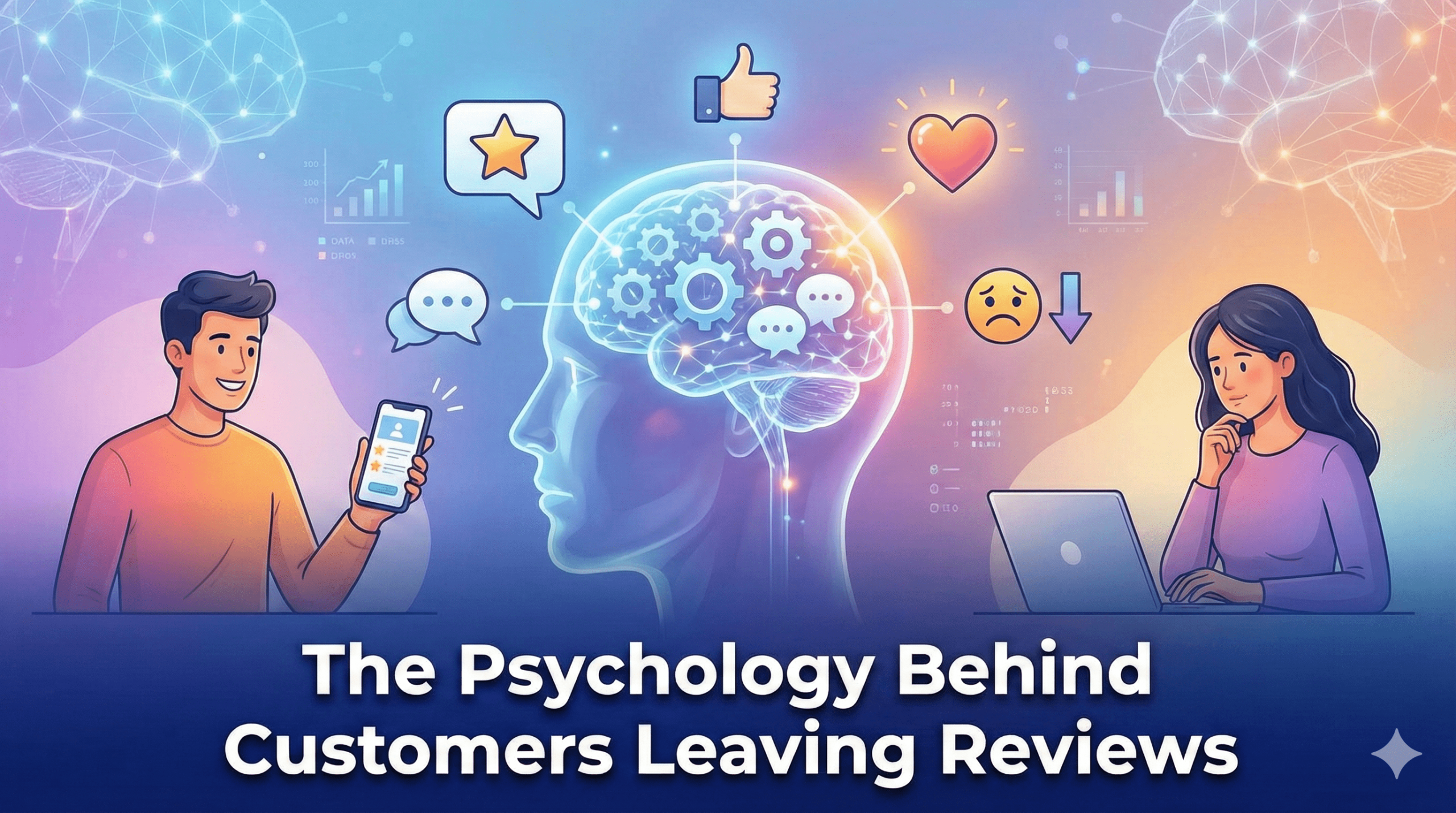
The Psychology Behind Customers Leaving Reviews (2025 Deep Dive)
Why people leave Google Reviews — and how businesses can use psychology to get more of them. Most businesses think customers leave reviews because they’re either very happy or very upset.
But the psychology of reviews is far more complex — and far more predictable. In 2025, understanding why customers leave reviews, what motivates them, and how small psychological triggers influence their behaviour is one of the most powerful tools a business can use to increase Google Reviews consistently.
This guide breaks it all down, along with actionable strategies that tap into real human behaviour — not guesswork.
⭐ Why Understanding Review Psychology Matters
Google Reviews aren’t just “opinions. “They are behavioural expressions influenced by:
- Emotion
- Motivation
- Memory
- Social influence
- Convenience
- Trust
- Reciprocation
When you understand these psychological motivators, you can ethically guide customers to leave more reviews — without incentives, without forcing, and without discomfort.
The result?
➡️ More reviews
➡️ More 5-star ratings
➡️ Higher Map Pack rankings
➡️ Better customer trust
➡️ Higher revenue
🔥 The 8 Core Psychological Drivers Behind Google Reviews
These are the exact mental triggers that influence a customer’s decision to leave a review.
1. Emotional Peak Moments (The Peak-End Rule)
Psychology shows that people remember two things best:
- The peak of the experience (highest emotion)
- The end of the experience (final moment)
This is called the Peak-End Rule. Customers leave reviews when:
- They experienced something excellent
- They experienced something terrible
- They had a strong emotional moment
This is why asking for a review right after the service ends is highly effective.
👉 Present your NFC Google Review Card at that emotional peak, and the customer is far more likely to submit a 5-star review.
2. Social Proof Influence (The Herd Effect)
People follow what others do. If a business has:
- Many reviews
- High star ratings
- Positive customer stories
New customers feel socially encouraged to validate the business through their own review. This is known as herd behaviour. Using a Google Review Plaque in-store amplifies this effect:
✔ Customers see other people trust you
✔ They want to contribute
✔ They feel their review matters
Social proof encourages more social proof.
3. Reciprocity (The Human Need to Give Back)
When people receive good service, they instinctively want to give something back.
If a business:
- Is kind
- Delivers great service
- Goes the extra mile
- Shows appreciation
Customers feel psychologically motivated to reciprocate — often through leaving a review. This is why soft asks like:
“If you had a good experience, we’d really appreciate a quick review.”
work incredibly well when paired with:
👉 Google Review Stands
👉 Review Cards
Reciprocation is one of the strongest ethical review motivators.
4. Cognitive Ease (The Brain Loves Simplicity)
Humans avoid tasks that feel complicated. If leaving a review takes:
❌ Searching your business
❌ Finding the right profile
❌ Clicking through menus
❌ Logging in
The customer won’t do it. The brain rejects effortful tasks. This is why NFC/QR tools skyrocket review submissions:
👉 Tap card → Review page opens → Customer writes review
Using:
- NFC Google Review Cards
- Google Review Stickers
- NFC Wristbands
reduces the process from 45 seconds → 2 seconds. Easy tasks = completed tasks.
5. Identity Alignment (“People Like to Be Seen as Helpful”)
Customers want to be seen — by themselves and others — as:
- Helpful
- Kind
- Supportive
- Community-minded
- Smart shoppers
Leaving a review is a self-expression behaviour.
By saying:
“Your feedback really helps other customers choose us.” you align the review with their identity. Good people want to help other good people. This drives review behaviour dramatically.
6. The “Fresh Memory Window” (90-Second Rule)
Psychology shows that people are most likely to take action within 90 seconds of a positive experience.
After 90 seconds:
- Motivation fades
- Memory weakens
- External distractions take over
This is why businesses that wait until later lose 90% of potential reviews.
When customers finish a service:
- Present a Review Card
- Invite them to tap
- Capture the review before the moment passes
This is how NFC Google Review Cards create instant review momentum.
7. The Zeigarnik Effect (People Want to “Complete the Loop”)
The Zeigarnik Effect states:
Humans are psychologically bothered by incomplete actions. If customers start the review process and it feels easy, they almost always finish it.
This means:
- When the Google Review page loads instantly
- When there’s no login barrier
- When they’re already in action mode
They complete the review because the brain wants closure. This is why frictionless NFC tools outperform sending links via email or SMS.
8. Trust Transfer Theory (Visual Proof = Behaviour)
When customers see visible trust elements:
- Review plaques
- High rating displays
- Counter stands
- Stickers with “Tap to leave a review”
Their subconscious concludes:
“This business must be trustworthy — and people review them.” And this encourages their own review behaviour.
Use:
👉 Google Review Plaque
👉 Google Review Stands
👉 Google Review Stickers
to amplify trust transfer.

🎯 How to Use Psychology to Increase Google Reviews FAST
Here are the most effective psychological triggers + tools:
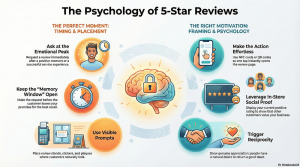
1. Ask at the emotional peak
Right after a positive moment, present the NFC Review Card.
2. Make the action effortless
Tap → Review page opens → Job done.
3. Use in-store social proof
Show your rating with a Review Plaque.
4. Leverage identity motivation
Explain how the review helps other customers.
5. Keep the “Memory Window” alive
Ask before the customer leaves your premises.
6. Use visible review prompts
Place stands and stickers where customers naturally look.
7. Encourage closure
Make the review process feel “half done” by loading the page instantly.
8. Trigger reciprocity
Show appreciation — people love giving back. These strategies are ethical, psychological, and extremely effective.
🧠 AEO FAQ: Psychology of Reviews (2025)
Why do customers leave reviews?
Because of emotional peaks, social proof, identity alignment, and reciprocity.
What stops customers from leaving reviews?
Friction, forgetfulness, and complex multi-step processes.
How can I influence customers to leave more reviews?
Remove friction, ask at the right moment, and use visible review prompts.
Do Google Review Cards increase reviews?
Yes. They work because they leverage cognitive ease and instant action.
Is it ethical to use psychology for reviews?
Yes — these principles reflect natural human behaviour and support honest feedback.
🏁 Final Thoughts: The Mind Behind the Review
If you want more Google Reviews, you don’t need luck — you need to understand human behaviour.
When you combine:
- Psychology
- Timing
- Simplicity
- Social proof
- NFC technology
You unlock the smoothest, strongest, and most ethical method to grow reviews fast. Start leveraging psychology today with the right tools:
👉 NFC Google Review Cards
👉 Google Review Stands
👉 Google Review Plaque
👉 Google Review Stickers
👉 Smart NFC Wristband
👉 Multi Review Card
These tools activate genuine customer motivation — leading to more reviews, better SEO, and stronger trust.